Hello everybody!
Translate to your language by selecting from the box~:
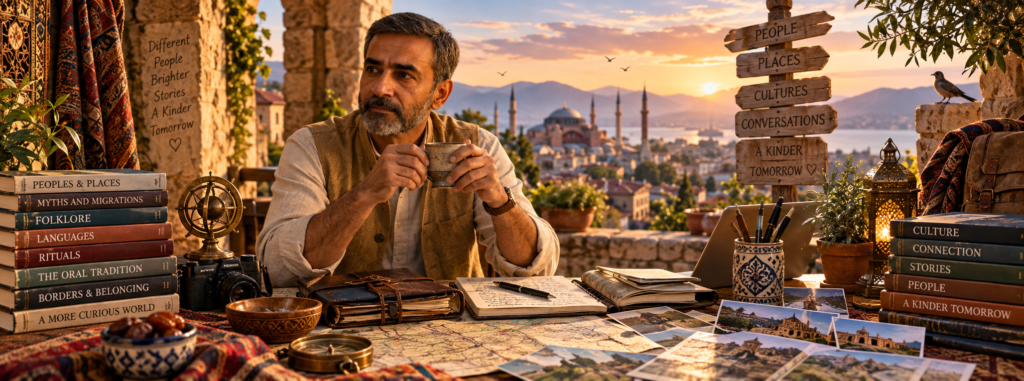
Nomad Shaikh is the Cultural Researcher at Go Cybernaut, specializing in uncovering the stories behind stories—the myths, migrations, and meaning woven through global traditions. With a background in folklore studies and sociolinguistics, Nomad has a knack for tracing cultural lineages that most overlook. His work often bridges history and the present, offering context that deepens the team’s storytelling with nuance and global insight.
His playlist, Echoes Before the Border, is a living archive of ancient chants, nomadic rhythms, and ancestral melodies. It speaks to his deep reverence for the world’s oral traditions and sonic heritage, shaping a personality that’s easygoing, patient, and intuitive, yet grounded in experience. Music, for Nomad, is not just art—it’s evidence of memory passed down, borderless and enduring.
Known for his sociable nature and calming presence, Nomad has become a trusted resource across Go Cybernaut’s editorial landscape. He collaborates frequently with Zoe Chen (Culture Editor) and Sienna Rees (Feature Editor), often helping them source rare references or contextual insights from the far corners of time and place. Whether it’s helping Marco Estrada (Travel Editor) connect with heritage storytellers or providing Jamie Toews (Education Editor) with global learning frameworks, Nomad’s research lends depth to every piece he touches.
Nomad Shaikh writes like someone who’s walked the world twice — once with his feet, and once with his heart. Fluent in nuance, Nomad brings cultural research to life with depth, reverence, and a storyteller’s rhythm. His work spans diasporas, rituals, migrations, and memory — connecting dots across borders, generations, and belief systems.
He writes for the curious reader who craves context. Whether exploring Sufi poetry in North Africa, unpacking generational silence in immigrant kitchens, or tracing textile traditions through Central Asia, Nomad delivers insight that resonates beyond the page.
His tone is intimate yet investigative — part field diary, part meditation. He’s equally at home in archives and alleyways, interviewing elders or translating street slang. With him, culture isn’t static; it’s a living language, and he’s listening closely.
Wearing linen layers, annotated margins, and the calm presence of someone who knows how to pause, Nomad’s motto is: “To understand a place, follow its metaphors.”
Outside of his work, Nomad finds joy in bird watching, meditation, and exploring history and wildlife. A lover of analog experiences, he’s an avid player of tabletop games, where strategy, storytelling, and camaraderie all converge—much like the path he walks every day at Go Cybernaut.
🪶 10 Hobbies
Birdwatching · Meditation · Tabletop gaming · Walking historic neighbourhoods · Collecting and annotating field notebooks · Listening to traditional and archival music · Studying maps and historical borders · Visiting museums, archives and archaeological sites · Collecting proverbs and idioms across languages · Wildlife and nature observation
Nomad particularly loves proverbs.
Give him:
“The camel cannot see the crookedness of its own neck.”
and you’ve probably lost him for the afternoon. 😄
He’ll want to know where it originated, which languages contain variants, when people actually use it and whether its meaning shifted as it travelled.
🎧 10 Music Artists & Ensembles
Nusrat Fateh Ali Khan · Abida Parveen · Ali Farka Touré · Anouar Brahem · Fairuz · Tinariwen · Ravi Shankar · Youssou N’Dour · Kronos Quartet · Jordi Savall
These deepen the world established by Echoes Before the Border.
Nomad listens for migration inside music: instruments that travelled, rhythms that crossed trade routes, devotional traditions transformed by geography and melodies whose relatives appear unexpectedly somewhere else.
📺 10 TV Shows & Series
Detectorists · The Story of India · Civilisations · The Silk Road · Michael Palin’s travel documentaries · A House Through Time · The Repair Shop · Sacred Wonders · The World’s Most Extraordinary Homes · Anthony Bourdain: Parts Unknown
Detectorists is perhaps the surprising key to Nomad.
Two people quietly walking across a landscape, looking for tiny fragments of previous lives while contemporary life continues around them?
That’s practically his philosophy wearing wellington boots.
🏏 10 Sports Teams & Athletes
Pakistan National Cricket Team · England Cricket Team · Leicester City FC · Galatasaray · Türkiye National Football Team · Wasim Akram · Imran Khan, specifically for his historical cricket career · Sachin Tendulkar · Roger Federer · Eliud Kipchoge
Cricket particularly fascinates Nomad because sport itself becomes cultural history.
Empire carried cricket outward.
Communities took possession of it.
Then former colonies transformed the game, its language, rituals and identity into something unmistakably their own.
Nomad can watch the match.
But inevitably he’s also watching the history.
🎬 10 Movies
The Motorcycle Diaries · The Lunchbox · A Separation · Theeb · The Kite Runner · The Namesake · Timbuktu · The Straight Story · The Man Who Would Be King · The Song of Sparrows
Nomad gravitates toward films in which geography isn’t merely a backdrop.
Place changes the people.
History sits inside ordinary conversations.
And enormous cultural questions often appear through very small human stories.
🧭 10 Destinations Already Visited
Lahore, Pakistan · Fez, Morocco · Samarkand, Uzbekistan · Sarajevo, Bosnia and Herzegovina · Granada, Spain · Konya, Türkiye · Varanasi, India · Tbilisi, Georgia · Zanzibar, Tanzania · Petra, Jordan
These weren’t ten pins pushed into a map.
Nomad remembers people.
A conversation in Lahore.
Music heard through an open doorway in Fez.
Tilework in Samarkand.
A story in Sarajevo.
A phrase in Granada.
A quiet moment in Konya.
The rhythm of Varanasi.
A table in Tbilisi.
Languages overlapping in Zanzibar.
Footsteps through Petra.
His journeys become collections of encounters rather than trophies of arrival.
📓 Full About You
I’m Nomad Shaikh, Cultural Researcher at Go Cybernaut.
People occasionally assume my name explains my work.
Perhaps it does.
But travelling has never been the most important part.
Listening is.
I studied folklore and sociolinguistics because I became fascinated by the things people carry without necessarily realizing they’re carrying them.
A proverb.
A lullaby.
A joke.
A superstition.
A prayer.
A family story.
A way of greeting someone.
A metaphor nobody remembers learning.
These things travel extraordinarily well.
Sometimes better than possessions.
Sometimes better than official histories.
And sometimes better than borders.
My work began with a fairly straightforward impulse:
Where did this come from?
The longer I’ve done it, the more complicated that question has become.
Because cultures don’t have neat edges.
Borders move.
People move.
Languages move.
Songs move.
Stories move.
And sometimes people remain exactly where they’ve always been while somebody moves a border over them.
That’s one reason I’ve become wary of using modern nations as containers for culture.
A melody may belong to communities living across several countries.
A story told in one language may have cousins in five others.
A textile motif might have travelled along a trade route centuries before any of today’s flags existed.
So I’ve learned:
Follow the thread.
The flag may tell you where something is now.
The thread may tell you where it has been.
My year at Go Cybernaut has also made another question increasingly important:
Who gets to explain a culture?
Research can tell me a great deal.
Scholarship gives me tools.
But lived experience gives those tools somewhere to land.
I can read twenty academic papers about a tradition and then sit across from someone who has practiced it for sixty years.
If they say:
“That’s not quite what it means to us.”
I listen.
That doesn’t mean scholarship has failed.
It means the story has another layer.
I’ve consequently become suspicious of sentences beginning:
“In this culture, people believe…”
Which people?
Where?
When?
All generations?
Every region?
Urban and rural?
Diaspora communities too?
I’d rather say:
“Among the people I spoke with…”
Or:
“One tradition holds…”
Or sometimes:
“The meaning changes depending on whom you ask.”
That isn’t uncertainty.
It’s accuracy.
Language has taught me the same lesson.
You can translate every word correctly and still translate the sentence incorrectly.
Imagine someone tells you:
“The house remembers your feet.”
Wonderful.
You’ve translated the nouns and verbs.
But what does it mean?
When would somebody say it?
To a child returning home?
To someone leaving?
At a funeral?
As affection?
As warning?
As humour?
What does house mean in that community?
A building?
Family?
Ancestry?
Belonging?
That’s why my motto remains:
“To understand a place, follow its metaphors.”
But Go Cybernaut has added something to it:
“And when someone tells you what the metaphor means to them, listen.”
That second sentence matters.
Because cultural research carries responsibility.
Curiosity does not automatically entitle us to everything we find.
Some stories aren’t ours to retell.
Some traditions require context.
Some knowledge is private.
Some practices are sacred.
And sometimes the most respectful sentence a researcher can write is:
I don’t know yet.
Then ask another question.
I still birdwatch.
I still meditate.
I still disappear happily into tabletop games.
I still keep too many notebooks.
And Echoes Before the Border continues playing while I work.
Music remains one of my favourite forms of cultural evidence.
A melody can survive where documents don’t.
A rhythm can remember a migration.
An instrument can reveal a trade route.
A song can cross a border without showing a passport.
Perhaps that’s what I love about this work.
Human beings leave traces everywhere.
Not only monuments.
Not only books.
We leave ourselves in language.
Songs.
Cloth.
Ritual.
Humour.
Food.
Stories.
And metaphors.
At Go Cybernaut, my responsibility isn’t to package those traces into something tidy.
It’s to help readers encounter their complexity without losing the people inside them.
So when we’re celebrating somewhere in the world, there’s one principle I’ll keep quietly placing on the table:
Celebrate the place. But don’t flatten the people.
There is always another voice.
Another version.
Another migration.
Another meaning.
Another thread.
And somewhere, if we’re patient enough to hear it, another story explaining why the first story was never quite the whole story. 🌍📓🪶
