Welcome!
Translate language by selecting from the box~:
A Bucket List Journey Through Stone, Spirit & Sunrise
Curated by Poppy for Go Cybernaut
There are places that seem to live in the imagination long before we ever arrive.
Angkor Wat is one of them.
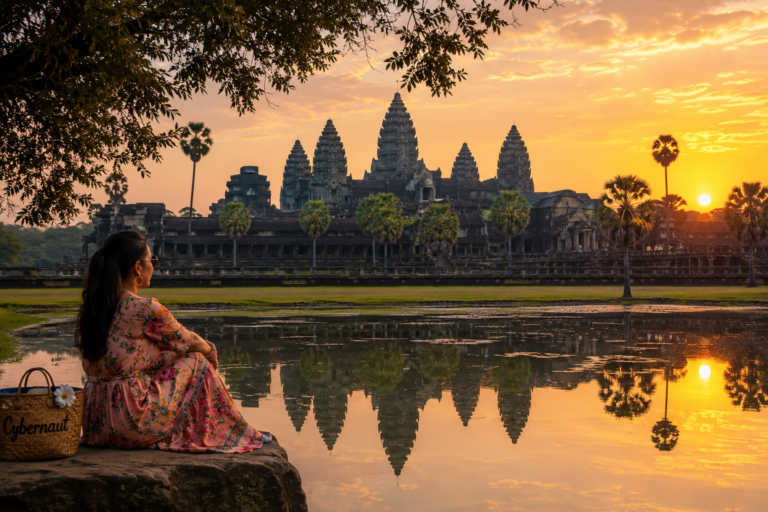
Five lotus-shaped towers rise above a broad moat. Ancient sandstone shifts from charcoal to gold as dawn reaches the temple. Palm trees gather at the horizon. Reflections tremble on the water. Somewhere nearby, the day begins with birdsong, bicycles, prayer, conversation, breakfast fires, and the ordinary life of a place that has never belonged only to the past.
Angkor Wat is often introduced through a single image: sunrise over the temple in Siem Reap, Cambodia.
It is a beautiful image. But it is only the doorway.
Angkor is not one monument to be hurried through with a camera and a checklist. It is an immense cultural landscape, a sacred heritage site, a record of Khmer artistry and ingenuity, and a living part of Cambodia’s story. To visit well is not to collect temples. It is to arrive with curiosity, move with care, and leave more reverent than you began.
For Poppy, Angkor Wat belongs on the Bucket List because it invites a rare kind of wonder: the kind that makes you slow down.
A Temple That Holds the Horizon
Angkor Wat stands within the Angkor Archaeological Park near Siem Reap in northwestern Cambodia. Built in the early 12th century during the Khmer Empire, it was first dedicated to Vishnu and later became an important Buddhist site.
Its scale is difficult to absorb all at once.
There is the moat that frames the temple like a quiet border between everyday life and sacred space. There is the long stone causeway leading inward. There are galleries filled with detailed bas-reliefs, towers rising into the Cambodian sky, and courtyards where light changes the colour of the stone hour by hour.
At first, most visitors look upward.
The central towers deserve their admiration. Yet Angkor Wat is also a place for looking closely.
Notice the worn steps underfoot. Notice the long walls carved with scenes of myth, battle, ceremony, and devotion. Notice the apsaras, celestial dancers whose delicate forms appear again and again across the sandstone. Notice the quiet pockets of shade, the softened voices in a passageway, the way weather and time have left their own signatures on the walls.
Angkor Wat does not ask to be conquered in an hour.
It asks to be received.
Sunrise Is Beautiful, but It Is Not the Whole Story
The sunrise view of Angkor Wat is one of the most recognizable travel scenes in the world.
Before dawn, visitors gather near the reflecting pools. The temple appears first as a silhouette. Then the sky begins its slow work, shifting through blue-grey, rose, apricot, lavender, or stormy silver. The towers emerge from darkness, mirrored in the water below.
It is extraordinary.
It can also be busy.
Poppy’s gentle suggestion is to let go of the idea that you must have the “perfect” sunrise photograph. The sky does not owe anyone a postcard. Mist, cloud, rain, soft grey light, and a quiet morning can be just as memorable as blazing gold.
Find a place that gives you breathing room. Step slightly away from the densest crowd. Put the camera down for a few minutes. Let yourself be present for the first light rather than only trying to preserve it.
Then, when many people move on to review their photographs, stay.
Walk into Angkor Wat. Let the galleries, courtyards, carvings, and corridors reveal themselves without hurry. This is often when the temple begins to feel less like an image and more like a place.
Angkor Is More Than Angkor Wat
Angkor Wat may be the most famous temple in Cambodia, but the greater Angkor landscape is an entire world of temples, waterways, forests, ancient roads, and human stories.
A meaningful visit does not require seeing everything. In fact, trying to see too much can blur the experience into heat, crowds, and tired feet.
Instead, choose a few places and let each one have room to speak.
Angkor Wat
Begin with Angkor Wat itself.
Its grandeur is obvious from a distance, but its details reward patience. The galleries contain some of the most remarkable carvings in the complex, with scenes that unfold across long walls like stone-bound epics.
Stand back to see the larger composition. Then move closer. Look at the gestures, clothing, faces, animals, patterns, and tiny details that may have taken generations of craft and care to create.
The temple is not only a structure. It is storytelling in stone.
Bayon at Angkor Thom
At the heart of Angkor Thom, Bayon offers an entirely different feeling.
Its towers are carved with serene faces looking in multiple directions. They appear unexpectedly as you move through the temple, emerging above doorways and stone corridors. There is something both watchful and tender about them.
Bayon is a place where photographs rarely capture the whole experience. The faces change with your angle. You may find yourself wondering who they are watching, what they have witnessed, and why they still seem so calm after centuries of rain, heat, conflict, restoration, and change.
It is a temple that makes you feel small in the best possible way.
Ta Prohm
Ta Prohm is known around the world for the giant roots and trees that curl through doorways and walls.
It is breathtaking. But it deserves more than its reputation as a “jungle temple.”
Ta Prohm tells a story about time. Stone and root have met here in a way that feels almost impossible, reminding us that the natural world does not politely wait outside the frame of human ambition.
Walk slowly. Stay on designated paths. Do not climb, lean on, or touch fragile surfaces. The most respectful traveller leaves behind no damage, no disruption, and no need to be remembered by the stones.
Banteay Srei
Further from the central temple area, Banteay Srei offers a smaller and more intricate experience.
Known for its richly carved pink sandstone, it feels intimate after the monumental scale of Angkor Wat and Angkor Thom. Its artistry is fine, detailed, and full of texture.
Banteay Srei is a reminder that grandeur does not always need to be enormous.
Sometimes it lives in a small carved flower, a delicate lintel, a doorway catching late-afternoon light, or a piece of craftsmanship that asks you to come closer.
A Living Heritage, Not a Backdrop
One of the most important things to understand before visiting Angkor is that it is not an abandoned fantasy landscape.
The temples remain sacred places. The broader Angkor area includes communities, worship, ritual, conservation work, agriculture, memory, and daily life. Cambodia is not a backdrop for someone else’s adventure story. It is a living country with its own voice, history, beauty, complexity, and future.
That understanding changes how we travel.
Dress respectfully when entering temple spaces. Cover shoulders and knees where required. Keep voices low in sacred areas. Do not touch carvings or statues. Do not climb on structures. Do not treat monks, worshippers, children, or local residents as photo props.
Listen when your guide or site signage asks something of you.
Respect is not an accessory to a meaningful trip. It is where the journey begins.
The stones have survived for centuries. Our task is not to leave our mark upon them.
Poppy’s Gentle Way Through Angkor
Angkor can be physically demanding.
Days may involve heat, humidity, uneven ground, steep stairs, narrow passages, long walks, limited shade, and sensory overload from crowds. There is no prize for pushing yourself beyond your limits.
A better journey is one built around your actual energy.
Begin early when temperatures are gentler. Plan a proper rest during the hottest part of the day. Return to Siem Reap for lunch, a swim, a shower, a quiet café, or simply a few hours indoors. Spread temple visits across several days where possible.
For travellers with chronic pain, mobility limitations, heat sensitivity, fatigue, or sensory needs, a trusted local guide and driver can make all the difference. A thoughtful route, regular water breaks, access to shade, and permission to skip a temple when your body says no can turn an overwhelming day into a beautiful one.
Bring shoes that are kind to your feet.
Bring water.
Bring sunscreen.
Bring patience.
And bring enough room in your plans for the unexpected moments that cannot be scheduled.
A Slow Three-Day Angkor Rhythm
Day One: Arrive Softly in Siem Reap
Let your first day be gentle.
Walk near the river. Rest at your hotel. Visit a local café. Browse a market without feeling pressure to buy. Enjoy a meal and begin learning the rhythm of the city.
Siem Reap is more than the place people sleep before seeing temples. It is a city of cooks, artists, musicians, craftspeople, families, students, and small businesses. Give it the chance to become part of the story.
Do not begin a great journey already exhausted.
Day Two: Angkor Wat and Angkor Thom
Wake early for Angkor Wat sunrise, holding your expectations lightly.
After the first light, explore Angkor Wat without rushing. Choose a few galleries, carvings, and viewpoints that matter to you. Sit when you need to sit. Look when you need to look. Let the temple be more than a photograph.
Take a genuine midday break.
Later in the afternoon, visit Angkor Thom and Bayon as the light begins to soften. Let the faces of Bayon become the last image of the day.
Day Three: Ta Prohm and a Quieter Temple
Visit Ta Prohm early, before its pathways become busiest.
Afterward, choose one additional temple that suits your energy and curiosity. This may be Banteay Srei, Preah Khan, Baphuon, or another site recommended by a trusted local guide.
Leave room for Siem Reap in the evening. Choose a Khmer-owned restaurant. Support local artists and makers. Attend a Cambodian cultural performance. Spend in ways that bring benefit back into the community rather than only into an itinerary.
A journey becomes richer when it leaves something good behind.
What to Carry Into the Experience
A visit to Angkor feels better when you travel lightly, both physically and emotionally.
Bring:
- A refillable water bottle and extra drinking water
- Sunscreen, a hat, and breathable clothing
- A light scarf or cover-up for temple spaces
- Comfortable shoes with grip for uneven stone and stairways
- A rain layer during wetter months
- A small amount of local spending money
- A camera, but not the pressure to document every second
- Curiosity without entitlement
- Patience when heat, weather, crowds, or temple access change your plans
Leave behind the urge to rush, perform, or prove that you “did” Angkor correctly.
There is no correct way to be moved by a place.
The Siem Reap Part of the Story
Angkor Wat may be the reason many travellers first come to Siem Reap, but it should not be the only reason they remember it.
Make time for Cambodian food beyond the familiar dishes. Learn the names of ingredients. Ask respectful questions. Support Khmer-owned restaurants, guides, makers, and businesses whenever possible.
A favourite memory may not be a grand temple moment at all.
It may be an iced coffee in a shaded courtyard. A bowl of something fragrant and comforting. Rain tapping against a balcony. A handmade textile. The sound of music drifting through an evening street. A conversation with someone who tells you what home means to them.
Travel becomes more meaningful when it allows a place to be itself.
Why Angkor Wat Belongs on a Bucket List
Angkor Wat belongs on a Bucket List because it rearranges your sense of scale.
It reminds us that human beings have always built toward the sky, shaped stories into stone, carried water, made offerings, mourned, celebrated, created beauty, and tried to leave something meaningful behind.
But it teaches something quieter, too.
The greatest places in the world are not ours to possess.
They are ours to encounter with care.
At Angkor Wat, morning light moves across stone that has held centuries of artistry, faith, weather, restoration, survival, and hope. You stand there for a few hours, perhaps with dust on your shoes and wonder in your chest, and understand that you are part of a much longer human story.
That is the gift.
Not simply seeing Angkor Wat.
But allowing Angkor Wat to make you a little more awake.
Go Cybernaut Bucket List Reflection
For the traveller who needs this journey:
The dreamer, the history lover, the quiet observer, the person rebuilding their sense of wonder, and anyone who needs to remember that beauty can endure.
Poppy’s travel intention:
“May we arrive with curiosity, walk with respect, and leave with more reverence than we brought.”
Before you go:
Confirm current entry requirements, ticket options, temple access, weather conditions, local guidance, and travel advisories through official sources before making plans. The temples have waited centuries. A little preparation is a kindness to yourself, the site, and the people who call this place home.
More to Explore
Google Maps – Explore Street View of Angkor Wat.
Inside Asia – The history and significance of Angkor – Cambodia’s greatest monument.
Smart History – From the Center for Public Art History.
Wikipedia – Andkor Wat, according to the Internet encyclopedia.
Purchase Tickets – For your visit.
Discover More
Cambodian New Year – The Cambodian New Year, celebrated from April 14 to 16, is also known as the Khmer New Year.
How 10 Cultures Celebrate May – May isn’t just flowers and graduation caps — it’s a month full of heritage, renewal, and celebration across cultures. From lantern festivals to ancestral rituals, these global traditions are rooted in joy, reflection, and connection.
World Photography Day – August 19th join the celebration, and have your photos featured!
Geography Awareness Week – The aim of Geography Awareness Week, which occurs every third week of November, from November 17–21 this year, is to raise awareness about the significance of geography to everyone’s lives and encourage people to consider their relationship with the environment
Cambodia Independence Day – Cambodia Independence Day is celebrated on November 9 each year.
Bodhi Day – Observed on December 8, Bodhi Day is observed to mark the moment that took place 2,500 years ago when Siddhartha Gautama achieved enlightenment and became the Buddha or ‘awakened one’.

Poppy Sawayama brings a poetic pulse to every passport stamp.
As Go Cybernaut’s Asia Travel Writer, she weaves lyrical narratives that transport readers beyond the itinerary and into the rhythm of lived experience—where alleyway jazz meets temple bells and street food markets shimmer in monsoon light.
Have you ever visited a mountain, lake, valley, or sacred-feeling landscape that made you move more slowly?
Come wander with us through more Go Cybernaut Bucket List destinations, where every journey is chosen for curiosity, care, wonder, and the possibility of finding a soft place to land.
Inspired by the 2026 Travel 365 Desk Calendar from Papp Publishing.
🌟 Support the Go Cybernaut Constellation
Go Cybernaut is a soft place for curiosity, music, discovery, and storytelling. Every article, playlist, and celebration is created to help people feel a little less alone and a little more inspired.
If something here brightened your day, you can help keep the constellation shining:
☕ Buy Me a Coffee
📚 Visit the Cybernaut Bookstore
🎶 Explore our curated playlists
✉️ Join the weekly newsletter
🛍️ Visit & Shop on Market Street
Every visit, share, and small contribution helps this creative space continue to grow.
Thank you for being part of the journey. 🌿
