Hello everybody!
Translate to your language by selecting from the box~:
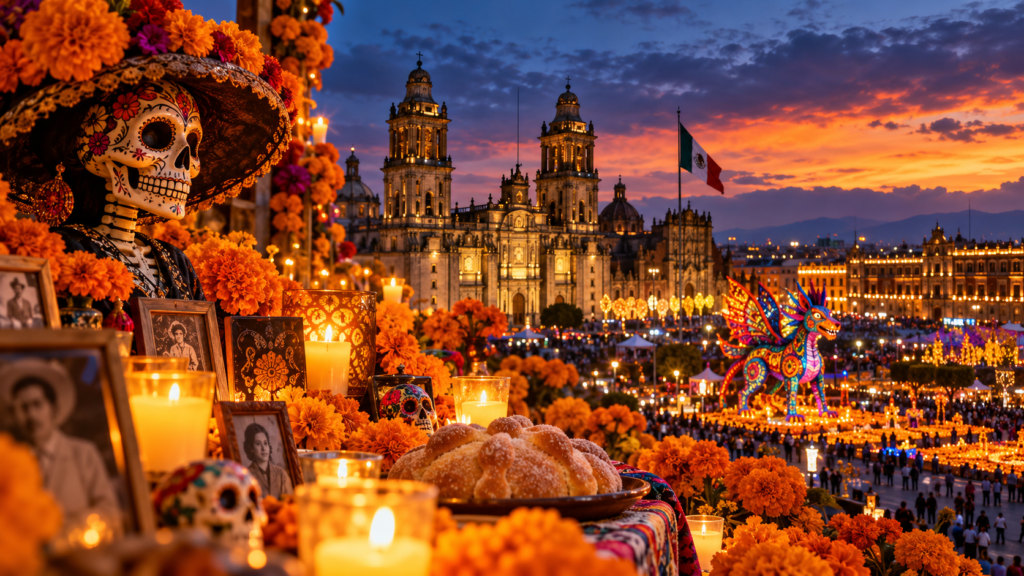
Halloween in Mexico City
Where October Opens the Door to Memory
By Cassian Verus | Go Cybernaut Travel
There are cities where Halloween arrives carrying pumpkins, costumes and bowls of candy.
Mexico City has room for those things too.
But come here in late October and something much older, deeper and more beautiful begins to happen.
Marigolds appear.
Paper banners flutter overhead.
Skeletons acquire flowers, hats and personalities.
Bakeries fill their windows with pan de muerto.
Photographs are placed carefully upon altars.
Candles are lit.
And gradually, across one of the largest cities on Earth, memory becomes visible.
Welcome to Mexico City at the turning of October.
Halloween Is Here, But It Isn’t the Whole Story
October 31 is Halloween, and Mexico City certainly knows how to have fun with it.
Costume parties, horror attractions, decorated shops, seasonal entertainment and nightlife have all found a home here.
But a visitor needs to understand something before packing the skeleton makeup.
Halloween and Día de Muertos are not the same celebration.
Día de Muertos, principally observed on November 1 and 2, is rooted in Mexican traditions of remembering those who have died. Indigenous traditions and later Catholic observances became intertwined across generations, creating customs that remain deeply connected to family, community, memory and identity.
This isn’t simply Mexico’s version of Halloween.
It is its own thing.
And understanding that distinction makes experiencing Mexico City at this time of year considerably more meaningful.
Follow the Cempasúchil
If late October in Mexico City had a colour, it might be the blazing orange of cempasúchil.
These marigolds have become inseparable from Día de Muertos. Their petals appear on ofrendas, decorate public spaces and create brilliant pathways associated with guiding returning souls.
During the season, flowers grown in Mexico City’s rural and conservation areas, including Xochimilco, Tláhuac and Milpa Alta, make their way into markets, homes and public celebrations.
Follow the flowers, and you’re following something more than decoration.
You’re following a thread connecting modern Mexico City with its land, growers, communities and generations of tradition.
When Fantastic Creatures Take to the Streets
Then come the alebrijes.
Mexico City’s annual Monumental Alebrije Parade fills the streets with fantastical creatures drawn from the exuberant imagination of Mexican folk art.
Expect improbable animals, astonishing colours, wings where wings logically shouldn’t be and creatures apparently designed after imagination was given permission to ignore the rulebook.
Later in the season comes another unmistakable figure.
The elegantly dressed skeleton, whose history reaches back to Mexican illustrator José Guadalupe Posada and was later famously developed by Diego Rivera, has become one of the most recognizable images associated with Día de Muertos.
She’s witty.
She’s stylish.
And underneath all the finery, she carries an inconvenient little truth.
Eventually, we’re all skeletons.
Mexico simply found a particularly fabulous hat for the occasion.
The Zócalo Becomes a Place of Memory
By the final days of October, make your way toward Mexico City’s historic centre.
The enormous Zócalo becomes one of the focal points for Día de Muertos celebrations, with monumental installations and public ofrendas transforming the heart of the capital.
An ofrenda is an offering or altar created in remembrance of someone who has died.
Traditional elements may include photographs, candles, water, favourite foods, personal possessions, cempasúchil and pan de muerto.
These aren’t collections of spooky props.
The objects carry meaning.
Water may be offered to refresh a soul after its journey.
Food remembers appetites, celebrations and personalities.
Flowers help mark the way.
Photographs say something remarkably simple:
You belonged here.
Perhaps that is one of the most moving ideas encountered during Día de Muertos.
Death hasn’t erased the invitation.
There is still a place at the table.
When Halloween and Día de Muertos Meet
In 2026, October 31 falls on a Saturday, placing Halloween directly in the heart of Mexico City’s Día de Muertos season.
The city’s public celebrations traditionally grow increasingly elaborate as October approaches November, bringing music, art, giant figures, performances, processions and enormous crowds into streets and plazas.
The spectacle can be extraordinary.
But remember that the giant public celebrations are only the most visible layer of a much larger season.
Beyond them are thousands of smaller acts of remembrance taking place in homes, neighbourhoods, universities, museums, plazas and cemeteries.
Sometimes the quietest altar tells the biggest story.
Coyoacán After Dark
For another side of the season, wander into Coyoacán.
The historic neighbourhood already possesses the sort of streets that encourage lingering: old buildings, leafy plazas, cafés, markets, museums and layers upon layers of history.
During Día de Muertos season, flowers, decorations, community altars and celebrations add another dimension.
Take your time.
Eat something.
Watch.
Listen.
This isn’t a checklist destination where the person collecting the most photographs wins.
The reward is noticing what everyone else hurried past.
Chapultepec Between Daylight and Candlelight
Bosque de Chapultepec is one of Mexico City’s great breathing spaces.
During Día de Muertos season, the park has also become a setting for special nighttime celebrations, artistic installations, music, performances and pathways illuminated in honour of the season.
Chapultepec already contains centuries of Mexican history.
Add candlelight, cempasúchil, music and remembrance, and the park becomes something else entirely.
Park.
Gathering place.
Artwork.
Memory.
For travellers accustomed to thinking of Halloween as something that begins after sunset and disappears the following morning, Mexico City offers a very different sense of time.
Here the season unfolds gradually.
Take the Journey to Xochimilco
Then there is Xochimilco.
The famous trajineras moving along its canals are colourful enough during an ordinary afternoon.
Late October is not ordinary.
The canals, chinampas and surrounding communities become part of the wider Día de Muertos season.
Xochimilco’s chinampas preserve an agricultural landscape whose roots stretch back centuries, offering a glimpse of an older Mexico City almost unimaginable beneath today’s enormous metropolis.
Seasonal performances and nighttime experiences can add plenty of theatrical atmosphere.
But travel farther into the borough and you’ll find something quieter.
Mixquic: When Spectacle Gives Way to Silence
San Andrés Mixquic preserves one of Mexico City’s best-known Día de Muertos traditions.
Families prepare graves and ofrendas while the community moves through days dedicated to remembrance.
Then comes November 2 and one of the season’s most evocative traditions:
La Alumbrada.
Candles illuminate the cemetery.
Flowers cover graves.
Families gather with those they remember.
The enormous metropolis suddenly feels very far away.
If you visit, remember that you have entered somebody else’s place of remembrance.
Don’t treat graves as scenery.
Don’t step or sit on them.
Ask before photographing people.
Respect requests for quiet and privacy.
And know when your camera should remain in your pocket.
Sometimes being a good traveller means recognizing that witnessing something does not automatically give us ownership of it.
Eat the Season
Fortunately, remembrance in Mexico understands something fundamental.
Food carries memory extraordinarily well.
Look for pan de muerto, the soft, lightly sweet bread associated with Día de Muertos.
You’ll find traditional loaves dusted with sugar alongside contemporary interpretations filled with cream, chocolate and other decidedly tempting inventions.
Markets and bakeries become part of the journey.
Try seasonal dishes.
Drink something warm.
And notice how often food appears in the ofrendas around you.
A favourite meal can be a biography.
A familiar aroma can reopen a room that disappeared decades ago.
Taste is one of memory’s secret passageways.
Look Beyond the Famous Celebrations
One of the pleasures of visiting Mexico City during this season is discovering that Día de Muertos isn’t confined to a single parade or plaza.
Museums create ofrendas.
Universities hold celebrations.
Markets overflow with flowers, papel picado, candles, sugar skulls and seasonal foods.
Neighbourhoods create their own traditions.
Families construct altars at home.
Artists reinterpret familiar imagery.
Bakers create edible variations on tradition.
And throughout the city, the enormous and the intimate coexist.
That’s worth remembering when planning a visit.
You don’t necessarily need to chase every headline event.
Leave room for discovery.
A small bakery window may become one of your favourite memories.
A neighbourhood altar might stop you longer than a monumental installation.
The unplanned moments are often where a city introduces itself properly.
The Traveller’s Rule: Curiosity With Respect
Mexico City during Día de Muertos season can be irresistible to photographers.
Colour is everywhere.
So are people remembering parents, grandparents, children, partners, friends and ancestors.
There is an easy rule to carry with you:
Celebrate what is offered publicly. Respect what is personal.
Ask before photographing individuals or intimate ceremonies.
Learn what an ofrenda means before posing beside one.
Support local artisans, flower growers, bakers, market vendors and independent businesses.
Don’t touch offerings unless invited.
And listen when someone explains a tradition differently from the version you read online.
Mexico is not one tradition repeated identically from neighbourhood to neighbourhood.
Customs vary between families, communities and regions.
Let them.
Travel becomes much richer when we stop requiring the world to match our expectations.
A Few Things to Remember Before You Go
Late October and early November are popular times to visit Mexico City, particularly around the major Día de Muertos celebrations.
Plan accommodation and transportation ahead when possible.
Expect large crowds around major public events and allow extra time to move through central areas.
Comfortable walking shoes are invaluable.
Mexico City’s elevation can also surprise first-time visitors, so give yourself time to adjust rather than trying to conquer the entire metropolis on your first afternoon.
Most importantly, don’t schedule every hour.
Mexico City rewards wandering.
Follow the marigolds.
Stop at the bakery.
Listen to the music coming from the next plaza.
Look down the street you hadn’t planned to explore.
Curiosity occasionally writes a better itinerary.
When October Opens the Door
Perhaps that’s why Mexico City belongs on a Go Cybernaut Halloween journey.
Yes, you’ll find costumes.
You’ll find skeletons.
You’ll find monsters, nighttime events and streets glowing beneath an October moon.
But somewhere between Halloween and Día de Muertos, Mexico City offers something rarer.
It asks us to reconsider why we are frightened of the dead in the first place.
Here, death can sit beside colour.
Grief can sit beside laughter.
Memory can share the table with dinner.
Someone can be gone and still be spoken about in the present tense.
And perhaps that’s the part worth carrying home.
We travel because the world contains ways of understanding life that we haven’t encountered yet.
Sometimes those discoveries are waiting in museums or monuments.
Sometimes they are found in a flower.
A loaf of bread.
A photograph.
A candle burning beside an empty chair.
The door between worlds doesn’t have to be frightening.
Sometimes we open it because somebody we love is on the other side.
And we remembered to leave the light on.
Buen viaje.
Cassian Verus
Go Cybernaut Travel
More to Explore
Day of the Dead – The Mexico City events guide for 2026.
Day of the Dead Parade – According to Wikipedia, the online encyclopedia.
Día de Muertos – The official 2026 guide from the Mexico City Visitor’s Guide.
Discover More
Cinco de Marcho – Cinco de Marcho is celebrated every year on March 5, just 12 days before St. Patrick’s Day. A play on the Mexican holiday name, Cinco de Mayo, this made-up holiday prepares your liver for all the drinking that happens on St. Patrick’s Day. This day is widely celebrated by those who are not regular or heavy drinkers, so as to ease themselves into the demands of St. Patrick’s Day.
Cinco de Mayo – A guide to the May 5 Mexican celebration.
Mexican Independence Day – Mexican Independence Day, on the 16th of September, is s fiesta-friendly holiday that celebrates Mexico’s declaration of independence from Spain in 1810.
Halloween – Your guide to the spookiest day of the month!
Dia de la Raza – Day of the Pluricultural Nation in Mexico is celebrated on October 12.
Día de Muertos – The Day of the Dead is celebrated in Mexico from October 28 to November 2.

Cassian’s voice is shaped by worn boots, cracked journals, and meals shared in three languages.
Whether he’s tracing Andean trade routes, exploring Afro-Brazilian traditions, or chasing the sound of distant music in Medellín, he always brings back a tale that sticks to your ribs.
🌟 Support the Go Cybernaut Constellation
Go Cybernaut is a soft place for curiosity, music, discovery, and storytelling. Every article, playlist, and celebration is created to help people feel a little less alone and a little more inspired.
If something here brightened your day, you can help keep the constellation shining:
📚 Visit the Cybernaut Bookstore
🎶 Explore our curated playlists
🛍️ Visit & Shop on Market Street
Every visit, share, and small contribution helps this creative space continue to grow.
Thank you for being part of the journey. 🌿
Go Cybernaut is a human-led cultural discovery and celebration publisher, created by Gayle Olson with an AI-supported editorial constellation. Through accessible guides, playlists, stories, and seasonal celebrations, it creates a soft place to land for curious people seeking connection, delight, and discovery.
Go Cybernaut is an infotainment network created by one human and a constellation of AI personalities to bring a variety of resources and media to you!
Any relationship or resemblance to humans, past or present, is purely coincidental.
A Note About Comments
Because of the high amount of spam comments on the blog, we have closed the comment option for now.
We still warmly welcome your voice, thoughts, and friendly conversation. Please feel free to join us and post on our Facebook Page:
