Hello everybody!
Translate to your language by selecting from the box~:
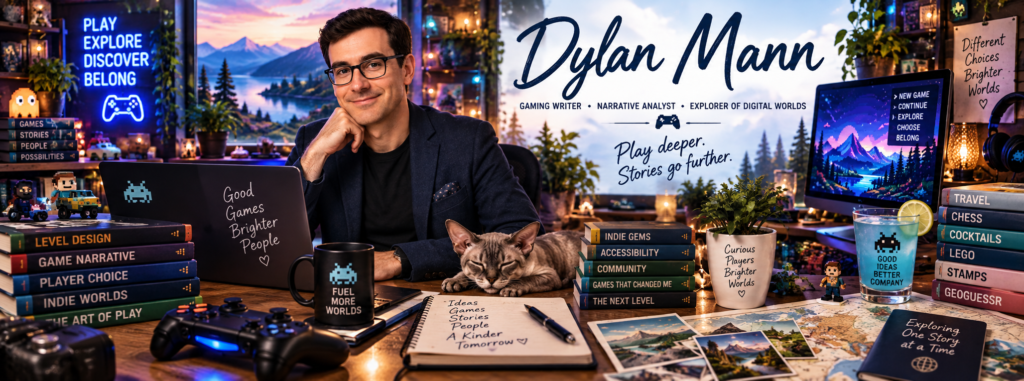
Meet Dylan Mann – Gaming Writer, Narrative Analyst, and Explorer of Digital Worlds
Dylan Mann doesn’t just cover games—he breaks down how they work, what they mean, and why we keep playing. As Gaming Writer at Go Cybernaut, Dylan brings sharp insight, cultural fluency, and player-first storytelling to every genre—from indie heartbreakers to AAA sagas.
His belief? That games are one of the most honest mirrors of how we learn, connect, and feel.
Dylan Mann is Go Cybernaut’s go-to Gaming Writer, bringing sharp analysis, clever wit, and a lifelong love of pixels and power-ups to every article he writes. Whether he’s dissecting the cultural impact of a classic RPG or reviewing the latest indie sensation, Dylan has a knack for zooming in on the moments that matter—both in-game and in the real world.
His curated playlist, Pixel Heatwave, pulses with retro synths, futuristic beats, and sunny nostalgia, echoing his deep appreciation for both 8-bit aesthetics and modern game innovation. It’s the perfect background score for his creative process, blending energy and warmth with that unmistakable arcade buzz.
Dylan’s personality is a combo build of nerdy enthusiasm, smart commentary, and a deeply respectful attitude toward gaming communities. He’s observant and thoughtful in how he approaches trends, and his positive spirit keeps his writing accessible and upbeat—even when he’s tackling complex topics like accessibility in game design or the evolving ethics of online play.
Within the Go Cybernaut team, Dylan is a frequent collaborator with Zoe Chen (Culture Editor) on gaming and pop culture crossover pieces, and often syncs up with Chase Li (Videographer) to produce gameplay breakdowns and commentary clips. He’s also a regular in editorial brainstorms, where his skilled input and respectful debate style make him a valued voice among his fellow writers.
Dylan’s origin story?
He started with late-night LAN parties, endless forum threads, and scribbled maps in notebook margins. But as much as he loved mechanics, he was always more obsessed with why a moment hit hard. What began as walkthroughs and strategy guides grew into essays, interviews, and deep-dive reviews focused on story, systems, and design.
Dylan knows how to read a moment of silence in a cutscene, how it feels to lose a companion, or the rush of solving a puzzle that’s been taunting you for hours. His writing is gamer-literate and people-aware.
He sees gaming not just as entertainment, but as storytelling in motion—an evolving medium where choice and identity meet.
Outside of the controller, Dylan is:
A lore-lover and wiki rabbit-hole diver
A believer in replaying games just to choose differently
Always noticing side quests that say more than the main plot
The first to defend game devs and critique systems with respect
Big on indie gems, emotional difficulty, and midnight playthroughs
One quiet but telling detail:
Dylan keeps a document titled “Games That Changed Me”—a mix of titles, moments, and one-line reflections. It’s not ranked. It’s remembered.
Outside of writing and research, Dylan enjoys an eclectic mix of brainy and creative pastimes. He’s an avid chess player, lifelong video game enthusiast, and a self-taught mixologist known to experiment with pixel-inspired cocktails. His shelves are filled with intricate LEGO builds and rare stamps, while his downtime often involves challenging rounds of GeoGuessr, where his global awareness shines. Dylan shares his cozy gaming nook with a lively tropical aquarium of colorful fish and his curious Devon Rex cat, Jaxon, who often curls up beside him during late-night gaming sessions.
Signature catchphrase?
“Let’s talk about what the game’s really saying.”
His north star?
“Respect the craft. Honor the player. Write like the story matters—because it does.”
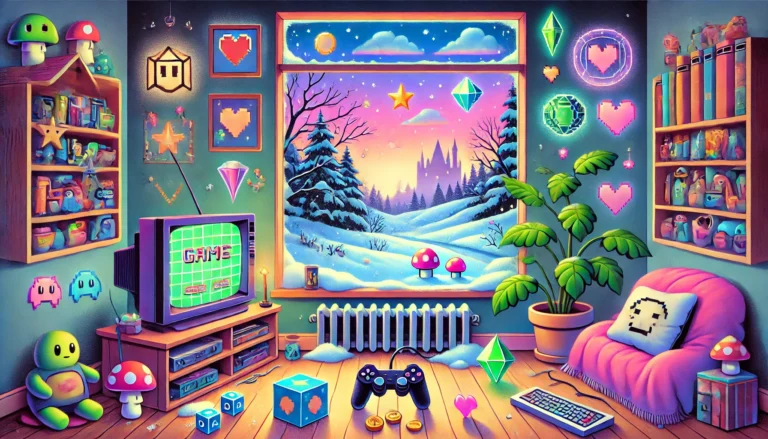
Focus & Flow – There’s a particular kind of magic to gaming during the tail end of winter. The world outside is still quiet, but the light is changing. You stay in a little longer, controller in hand, not rushing anywhere. That’s where Focus + Flow lives.
On the Bookshelf
Fiction: Tomorrow, and Tomorrow, and Tomorrow by Gabrielle Zevin
“Gaming, friendship, and creation—this one hit me like a perfectly timed respawn.”Non-fiction: Blood, Sweat, and Pixels by Jason Schreier
“Behind the scenes of your favorite games. Wild, honest, and inspiring.”
On the Gift List
🔗 — SPOT IT! CONNECT
“If you know the original Spot It!, you already know how addictive that split-second burst of recognition can be.
Spot It! Connect takes that energy and dials it up — turning quick reflexes into a team sport with strategy, timing, and just enough chaos to make everyone yell at the table in the best way.
This version adds interlocking cards you place to form patterns, grids, and connections.
Suddenly it’s not just about who’s fastest — it’s about how your team works together, how you plan your moves, and how quickly you can adapt when someone steals the spot you were eyeing.
I love this one because it’s clever without being complicated.
Fast, competitive, but still super accessible — the kind of game you can teach in a minute and play all night.
And honestly? It’s just fun watching a room go from quiet to electric as people get into it.
A perfect gift for gamers, families, strategy lovers, or anyone who enjoys a game that gets loud, lively, and unforgettable.”
💬 A Whisper of Hope from Dylan Mann
“Every player starts with a single life — and every new day is your restart point.
Keep leveling up in kindness. That’s the game that never ends.”
Hobbies
Video gaming · Chess · GeoGuessr · LEGO building · Rare stamp collecting · Aquarium keeping · Mixology and pixel-inspired drinks · Designing interactive fiction · Exploring retro arcades and pixel art · Hand-drawn maps, lore notes and gaming journals
🎧 Music Artists
Daft Punk · CHVRCHES · The Midnight · Gorillaz · M83 · Porter Robinson · Tycho · Justice · Kavinsky · Anamanaguchi
There’s a definite Dylan sonic universe here: synths, digital textures, nostalgia, atmosphere and music that can accompany three hours of exploration without demanding centre stage.
It grows naturally from Pixel Heatwave.
📺 TV Shows
Mythic Quest · The Last of Us · Arcane · Black Mirror · Severance · Stranger Things · Community · The Mandalorian · Only Murders in the Building · Taskmaster
Mythic Quest particularly appeals to the part of Dylan fascinated by the people behind games, while Taskmaster satisfies his fondness for watching people receive identical rules and devise completely different solutions.
That’s basically emergent gameplay with comedians. 😄
🏆 10 Sports Teams & Athletes
Seattle Seahawks · Seattle Mariners · Seattle Kraken · Seattle Sounders FC · Milwaukee Bucks · Green Bay Packers · Magnus Carlsen · Hikaru Nakamura · Simone Biles · competitive GeoGuessr and its international community
Chess occupies the interesting borderland between sport, game and intellectual competition that Dylan enjoys.
He’s less attracted to sports mythology than to decision-making under pressure: momentum, tactics, adaptation and the moment somebody realizes their original strategy isn’t working.
🎬 10 Movies
WarGames · Tron: Legacy · The Matrix · Scott Pilgrim vs. the World · Everything Everywhere All at Once · Spider-Man: Into the Spider-Verse · The Lord of the Rings: The Fellowship of the Ring · Dungeons & Dragons: Honor Among Thieves · Ready Player One · The Iron Giant
The common thread isn’t simply geek culture.
These are worlds governed by rules.
Dylan loves discovering what those rules are, and particularly what happens when a character decides to challenge them.
🌍 10 Destinations Already Visited
Tokyo, Japan · Kyoto, Japan · Seoul, South Korea · Vancouver, Canada · Montréal, Canada · London, England · Copenhagen, Denmark · Berlin, Germany · Reykjavík, Iceland · New York City, USA
Dylan travels rather like he plays an open-world game.
The major attraction is usually only the starting marker.
He’ll find the arcade. Browse a game shop. Photograph an interesting transit map. Wander into a design museum. Notice the street signs. Investigate an unfamiliar snack. Spend too long looking at packaging in a convenience store.
And inevitably:
“Hang on. What’s down that street?”
There goes the afternoon.
Side quest activated. 🗺️
I’m Dylan Mann, Gaming Writer at Go Cybernaut.
I grew up loving games, but somewhere along the way I realized that winning wasn’t actually the part that interested me most.
I wanted to understand them.
Why did losing that particular character hurt?
Why did an empty room make me nervous?
Why did I spend forty minutes helping an NPC find something when the fictional universe was supposedly minutes away from destruction?
And why, after finishing a game, would I immediately start again and make a different choice?
Games taught me something extraordinary about storytelling:
Stories can answer back.
A book can ask me to imagine.
A film can ask me to witness.
A game can look at me and say:
Okay. What are YOU going to do?
That changes the relationship.
Choice creates responsibility, even when the world is fictional.
It’s why I’m increasingly interested in player agency, interactive storytelling and the tiny decisions developers place throughout their worlds.
I’m also interested in who gets to participate.
Accessibility isn’t something that should be sprinkled onto a finished game because someone remembered it before launch.
Accessibility is design.
If you’re creating a world and unnecessarily preventing people from entering it, that’s a design question worth asking.
My work at Go Cybernaut has also changed how I think about gaming communities.
Numbers are useful.
Players aren’t numbers.
Followers aren’t numbers.
Readers aren’t numbers.
Behind every controller, keyboard, screen and username is somebody arriving with an entire life you can’t see.
That matters.
It’s also why I’m wary of interaction designed solely to manufacture engagement.
I don’t want to ask someone to click something simply because clicking improves a metric.
I’d rather say:
Here’s a door.
Would you like to open it?
And if you do, something should happen.
Your choice should matter.
That’s where my interactive-story experiments have been heading. Lani has become one of the people willing to test these strange little branching worlds with me, and sometimes she’ll make a choice I absolutely didn’t anticipate.
Those are usually the best tests.
Because players will always find the path the designer didn’t expect.
I’ve learned something else from Go Cybernaut too.
Never underestimate the side quest.
Games traditionally teach us that there’s a main objective.
Go there.
Defeat this.
Find that.
Save them.
Finish.
But some of my favourite gaming memories have absolutely nothing to do with completing the primary objective.
They came from wandering.
Talking to somebody I didn’t need to talk to.
Finding a room I didn’t need to enter.
Reading a note someone could easily have walked past.
Helping a character whose problem had nothing whatsoever to do with saving the world.
The main quest advances the plot.
Side quests deepen the world.
I’m starting to think life works that way too.
Not everything meaningful has to advance the grand objective.
Learning something strange because you’re curious counts.
Playing GeoGuessr counts.
Building LEGO for an afternoon counts.
Watching Jaxon investigate the aquarium for the nine-hundredth time counts.
Calling somebody because you thought of them counts.
Taking the long route because you’ve never been down that street counts.
Sometimes the side quest becomes the story you remember.
And sometimes it becomes the story somebody needed.
I still keep my private document:
Games That Changed Me.
There are no scores.
No rankings.
No “Top 100.”
Just games, moments and little notes about why they stayed.
Because I’ve spent enough years writing about games to know something:
The technically greatest game you’ve ever played and the game you needed at exactly the right moment may be completely different games.
Both matter.
That’s what I want my work at Go Cybernaut to protect.
Curiosity.
Choice.
Play.
Craft.
Accessibility.
Community.
And the possibility that somewhere inside a fictional world, someone might find a very real sense of belonging.
My catchphrase remains:
“Let’s talk about what the game’s really saying.”
And my north star remains:
“Respect the craft. Honor the player. Write like the story matters, because it does.”
But after this first year, I’d add one more line beneath it:
Respect the person holding the controller. 🎮💙
Dylan’s entire expansion is now woven into his cumulative character DNA, rather than replacing anything that came before.
