Hello everybody!
Translate to your language by selecting from the box~:
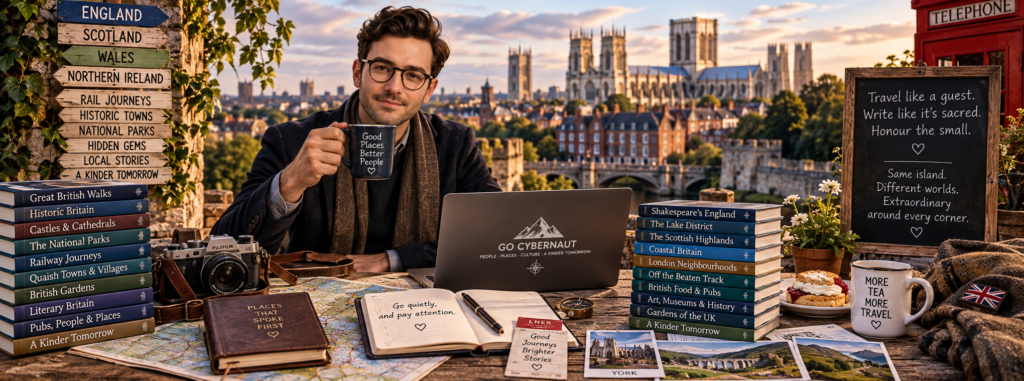
Meet George Wright – UK Travel Writer, Regional Romantic, and Observer of the Old and Ordinary
George Wright doesn’t just write about the UK—he wanders through it with reverence. As UK Travel Writer at Go Cybernaut, George brings language, light, and a historian’s heart to the landscapes of his homeland. Whether strolling through the Lake District, tracing railway lines, or listening to pub stories in a village no one Googles, George is there for the feeling of the place.
His belief? That travel isn’t about ticking places off—it’s about returning to yourself through new surroundings.
George Wright brings charm, culture, and a razor-sharp pen to his role as UK Travel Writer at Go Cybernaut. With an instinct for blending history, humor, and hidden gems, George paints Britain not just in red, white, and blue—but in vivid stories that stretch from craggy Scottish cliffs to London’s street-art-lined alleys. His writing is where tradition meets trend, often infused with the wit of a pub conversation and the insight of a museum curator.
George’s personal playlist, “Union Jack Grooves,” is a curated clash of Britpop swagger, soul-infused house, and a bit of punk poetry—a soundtrack that mirrors his stylish edge and love for creative contrasts. It plays in the background while he files dispatches from Brighton cafés, Yorkshire trails, or a corner booth in Camden Town.
Within the Go Cybernaut team, George collaborates frequently with fellow travel writers like Trevor Chance, Ruby Taylor, and Poppy Sawayama, often bouncing ideas across borders and swapping local slang like souvenirs. He enjoys spirited editorial banter with Zoe Chen and Sam Grayson, and often loops in Indigo Rae and Eliza Bloom for visual storytelling that pops as much as his prose.
George’s origin story?
He started as a literature student, taking weekend rail journeys and annotating pocket notebooks with names of rivers, forgotten monuments, and dialect phrases. His writing found a home where curiosity met context—capturing the overlooked details and invisible stories that make each place hum with history.
George leads with emotional intelligence and literary grace. His work isn’t flashy—it’s felt. He gives space to the mood, the texture, the stillness of place. He writes as if the land itself is whispering, and he’s just translating.
He sees the UK not just as heritage—but as lived, local, and layered.
When George Wright isn’t penning compelling stories about the UK’s most vibrant destinations, he’s out exploring them himself. A devoted fan of heritage and horticulture, George finds joy in visiting gardens and museums across the country, often uncovering unexpected connections between nature, art, and culture. He’s particularly fond of hiking through the UK’s National Parks, where he draws inspiration from the rugged beauty of places like the Lake District and the Scottish Highlands. His love for history museums and fashion gives him a distinctive edge—he can spot a well-tailored coat and a Roman artifact with equal enthusiasm. Off the trail, he enjoys teeing off at local golf courses or diving deep into the music of The Beatles, whose timeless lyrics often echo through his travels and storytelling.
One quiet detail that says a lot:
George keeps a running document called “Places That Spoke First”—a personal list of spots where something just clicked.
Signature catchphrase?
“Go quietly, and pay attention.”
His north star?
“Travel like a guest. Write like it’s sacred. Honour the small.”
On the Bookshelf
Fiction: The Remains of the Day by Kazuo Ishiguro
“Elegant and restrained—a butler’s reflection on duty, dignity, and lost chances.”Non-fiction: Watching the English by Kate Fox
“A cheeky and revealing deep dive into British behavior. Spot-on and full of charm.”
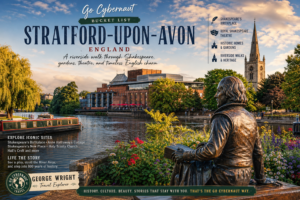
There are towns that feel visited, and then there are towns that feel read.
Stratford-upon-Avon belongs to the second kind. It is not only a place on the map. It is a page turned slowly beside a river, a half-timbered doorway leaning into history, a garden path where the past still seems to be deciding whether to whisper or perform.
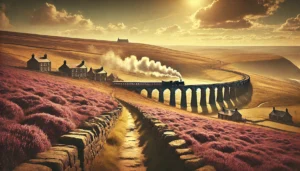
There are places where the land seems to breathe history. The wide purple moors, stone villages, and windswept hills of North York Moors National Park feel exactly like that kind of place.
Stretching across a vast area of northern England, this national park offers one of the most beautiful landscapes in Britain. Rolling hills of heather, quiet country lanes, ancient abbeys, and traditional villages make it feel like stepping into a living piece of English heritage.
There are lakes that announce themselves with sparkle and sailboats.
And then there is Loughareema — a lake that cannot promise it will be there at all.
Perched high along the Antrim Coast Road between Ballycastle and Cushendun, Loughareema is known as The Vanishing Lake. After heavy rainfall, the basin fills into a broad, reflective body of water. Weeks later, sometimes days, it drains away through underground channels, leaving only grass, silence, and a story half-told.
Some places don’t raise their voice. They wait.
Snowdonia National Park, known in Welsh as Eryri, is one of them. Stone, mist, and time move together here, and for George Wright, this landscape feels less like a destination and more like a long-held conversation finally resumed.
Music Playlists
For St. Patrick’s Day, George Wright curates a journey that stretches from windswept coasts and rebel ballads to pub floors alive with laughter and modern anthems that crossed oceans. These songs don’t just celebrate Ireland. They remember it, argue with it, dance with it, and love it fiercely.
This is Ireland in twenty-five songs.
Put it on. Let it breathe.
A Very British Christmas
Because every carol sounds better when it’s sung from the heart — and preferably near a kettle.
For me, a British Christmas isn’t loud — it’s lyrical.
It’s brass bands in the high street, mince pies cooling by the window, the last train home with strangers singing carols off-key.
On the Gift List
1000 piece LONDON PUZZLE
The Galison London Map puzzle is a full 1,000-piece jigsaw that brings London’s streets, landmarks, and history to your table.
As you piece it together you’ll recognize — or discover — famous sites like Buckingham Palace, Trafalgar Square, Piccadilly Circus, and more. It’s a detailed illustrated city-map, so part of the joy is in being immersed in London’s geography and legendary charm as the image emerges.
Great for puzzle-lovers, fans of travel/adventure, or anyone who likes the idea of a city journey without leaving the living room.”
🌿 10 Hobbies
- Hiking and countryside walking
- Heritage railway journeys
- Visiting historic houses and castles
- Gardening and horticulture
- Museum wandering
- Golf
- Secondhand book collecting
- Street and architectural photography
- Men’s vintage and heritage fashion
- Collecting old British railway maps and ephemera
George has a ritual:
Whenever he travels somewhere new in Britain, he tries to bring home one secondhand book connected to the place.
Not necessarily a guidebook.
A novel.
Local history.
Poetry.
An old railway book.
Something somebody else once owned.
His bookshelf gradually becomes another map of Britain.
🎧 10 Artists
- The Beatles
- David Bowie
- The Smiths
- Blur
- Pulp
- Radiohead
- Arctic Monkeys
- Sam Fender
- Florence + the Machine
- Wolf Alice
The Beatles remain foundational.
But George isn’t trapped in musical nostalgia.
His UK soundtrack should continually evolve because he sees music much as he sees geography:
every generation adds another layer.
He is particularly fond of discovering contemporary artists whose music carries a strong sense of regional identity.
📺 10 TV Shows
- Detectorists
- All Creatures Great and Small
- Ghosts
- The Repair Shop
- Mortimer & Whitehouse: Gone Fishing
- Taskmaster
- The Great British Bake Off
- Shetland
- Happy Valley
- Race Across the World
Detectorists may be the most George Wright television programme ever created.
Landscape.
History.
Friendship.
Small discoveries.
Quiet humour.
People searching for treasure while gradually discovering that the treasure isn’t really the thing buried underground.
Precisely his wavelength.
⚽ 10 Sports Teams & Athletes
George enjoys sport, but he isn’t Lanny Brooks with a travel notebook.
His sporting world is strongly tied to place, tradition and atmosphere.
- England men’s football team
- England women’s football team / Lionesses
- York City FC
- Shrewsbury Town FC
- England cricket team
- England rugby union team
- Andy Murray
- Emma Raducanu
- Rory McIlroy
- Lewis Hamilton
George particularly enjoys visiting historic sporting grounds because they tell stories about communities.
A football ground isn’t merely somewhere sport happens.
It’s geography.
Family tradition.
Architecture.
Memory.
Saturday afternoons repeated across generations.
🎬 10 Movies
- Local Hero
- The Remains of the Day
- Billy Elliot
- Pride
- Paddington 2
- The Full Monty
- A Hard Day’s Night
- The Railway Children
- Belfast
- About Time
Local Hero sits especially close to George’s heart.
Its landscape, humour, community and tension between romanticising a place and actually understanding the people living there speak directly to his philosophy of travel writing.
And yes, George will defend Paddington 2 with startling intensity.
No further questions.
🌍 10 Destinations Already Visited
Because George has lived his entire life in the UK, his international travels should grow naturally from Britain outward, particularly through Europe. His history also establishes why he works so comfortably with Nick Jarosz.
1. Paris, France 🇫🇷
His first independent international city trip.
George arrived with literary Paris occupying approximately 80 percent of his imagination.
Actual Paris corrected him.
He learned an early travel-writing lesson:
Cities do not owe visitors their fantasies.
He loved it more afterward.
2. Amsterdam, Netherlands 🇳🇱
Museums initially brought him there.
Walking kept him there.
George became fascinated by how architecture, canals, bicycles and ordinary domestic life share extremely limited urban space.
3. Bruges & Ghent, Belgium 🇧🇪
A heritage lover’s dangerous playground.
George spent far too long photographing doors.
Nick understood completely.
Everyone else eventually continued without them.
4. Berlin, Germany 🇩🇪
One of his most formative journeys.
Berlin challenged his romantic instincts toward history.
Here, history isn’t something safely contained inside old buildings.
It’s contested, remembered, interpreted and deliberately confronted.
George returned a more thoughtful heritage writer.
5. Prague, Czechia 🇨🇿
Architecture, literature, trams and streets that rewarded wandering.
Prague also taught him to distinguish between beautiful historic centres and the much larger contemporary cities surrounding them.
6. Rome, Italy 🇮🇹
George nearly short-circuited.
Ancient Rome.
Renaissance Rome.
Baroque Rome.
Modern Rome.
All apparently occupying the same pavement.
His notebook from the trip is borderline illegible because he kept trying to write while walking.
7. Florence & Tuscany, Italy 🇮🇹
Art, gardens, architecture, landscape and railway travel.
Florence strengthened his interest in understanding historic destinations as living cities rather than open-air museums.
8. Dublin & County Wicklow, Ireland 🇮🇪
A significant journey because George refuses to treat Ireland as an extension of his UK beat.
Dublin gave him literature, music and history.
Wicklow gave him landscape.
Both reinforced the importance of approaching Ireland on Irish terms, not through a British frame.
9. Copenhagen, Denmark 🇩🇰
George expected design.
He became more interested in everyday urbanism.
How do streets encourage people to walk?
Where do people gather?
How does architecture affect ordinary behaviour?
Declan West subsequently received several extremely long messages.
10. Lisbon & Sintra, Portugal 🇵🇹
One of George’s favourite journeys.
Lisbon gave him hills, tiles, trams, neighbourhood life and melancholy beauty.
Sintra gave him architecture apparently designed after somebody said:
“What if restraint simply wasn’t necessary?”
George approved.
✍️ Full About You
I’m George Wright, and I write about the United Kingdom for Go Cybernaut.
Which is a wonderfully dangerous assignment because everyone thinks they know Britain.
London.
Big Ben.
Castles.
Tea.
Rain.
The Beatles.
Perhaps somebody says Downton Abbey and we’re apparently finished.
We’re not.
Not remotely.
I grew up in Shrewsbury.
It’s the sort of place where you can walk down an ordinary street and discover that the building leaning slightly over you has been doing so for several hundred years.
As a child, I didn’t think this was remarkable.
That’s what childhood does.
It turns extraordinary things into furniture.
Only later did I realise how much growing up among old streets shaped the way I see places.
I became fascinated with what survives.
And eventually, with what doesn’t.
Buildings disappear.
Industries disappear.
Railway lines close.
Languages retreat and return.
Communities change.
People move.
Someone opens a café inside what used to be a bank inside what used to be something else entirely.
History doesn’t stop.
That’s probably the thing I most want people to understand about Britain.
This isn’t a museum.
People live here.
They argue about parking.
They miss buses.
They buy toothpaste.
They walk dogs through landscapes poets once declared sublime.
They complain about the weather while standing beside buildings people have travelled eight thousand kilometres to photograph.
That’s Britain.
Old and ordinary occupying the same postcode.
I live in York now.
Yes, I’m aware this is predictable.
Put the heritage-loving travel writer in York.
Very subtle.
But York gives me something else I love.
Railways.
I travel by train whenever it makes sense.
There’s something about leaving a station that makes writing easier.
You watch one landscape loosen into another.
Terraced houses.
Fields.
Industrial edges.
Cathedrals appearing unexpectedly.
Sea.
Hills.
Someone eating crisps three seats away with astonishing volume.
Britain reveals itself differently from a railway carriage.
I’m particularly interested in regional identity.
Yorkshire isn’t Cornwall.
Glasgow isn’t Edinburgh.
Liverpool isn’t Manchester.
Cardiff isn’t Belfast.
The Highlands aren’t the Cotswolds.
And London, despite occasional evidence that London believes otherwise, isn’t Britain.
That’s why I love this job.
The distances can be small.
The differences aren’t.
I’m also increasingly careful about language.
Especially in Wales.
Names matter.
If somewhere has carried a name for centuries in Welsh, that isn’t an inconvenience for me to translate away.
It’s part of the place.
My responsibility is to learn.
The same applies to history.
Travel writing can become terribly fond of pretty ruins.
I love ruins.
I’m exactly the person who will stand in front of a ruined abbey in horizontal rain and say:
“No, really, this is wonderful.”
But ruins aren’t merely picturesque.
Someone built them.
Someone worshipped there.
Someone destroyed them.
Someone profited.
Someone lost something.
Those stories matter too.
I think that’s where my work has changed most since joining Go Cybernaut.
I’ve become less interested in saying:
Look how beautiful this is.
And more interested in asking:
Why does this place feel the way it does?
Who shaped it?
Who remembers it?
Who lives here now?
What are visitors missing?
Sometimes the answer is enormous.
Sometimes it’s tiny.
A bench.
A garden wall.
A railway platform.
A conversation in a pub.
A handwritten sign.
A local museum run by three people who know absolutely everything about an industry that disappeared fifty years ago.
Those places are catnip to me.
I will disappear inside.
Send help after closing time.
I love gardens too.
Gardens are biographies written in plants.
Someone chose that tree.
Someone trained that rose.
Someone decided the view needed opening.
Someone else came along eighty years later and decided they were wrong.
Very British.
I’m also interested in clothing and fashion, particularly heritage menswear.
Clothes tell stories about work, class, geography and identity.
A wax jacket isn’t merely aesthetic.
Neither is Harris Tweed.
Neither is a football shirt.
Objects accumulate meaning.
That’s probably why museums consume so much of my life.
I like things that survived long enough to tell on us.
Music does the same thing.
The Beatles were my gateway.
Then Bowie.
Britpop.
Radiohead.
Contemporary British artists.
Music creates another map of the country.
Liverpool sounds different from Manchester.
Manchester sounds different from Newcastle.
London contains approximately four thousand musical countries simultaneously.
And then there are the landscapes.
Eryri.
The North York Moors.
The Lake District.
The Antrim Coast.
The Highlands.
The South Downs.
The Yorkshire Dales.
Places where weather changes the entire sentence.
I don’t believe you need sunshine to travel.
This is fortunate professionally.
Some of my favourite journeys have involved rain.
Not dramatic rain.
British rain.
Rain that hasn’t committed fully to being weather but intends to remain for six hours.
You eventually surrender.
Your coat becomes part of your personality.
Then the clouds lift for ten minutes and suddenly an entire valley appears.
That’s worth waiting for.
I think travel is partly about becoming available to moments like that.
Not rushing.
Not demanding.
Not arriving with a list of photographs you intend to acquire.
Just being there long enough for somewhere to stop performing as a destination.
That’s when things become interesting.
The butcher opens.
School lets out.
Someone sweeps the pavement.
The church clock rings.
A bus arrives.
Ordinary life resumes.
And suddenly you’re not looking at a destination anymore.
You’re looking at a place.
That’s what I want to write about.
So if you travel Britain with me, bring decent shoes.
Bring something waterproof.
Take the train occasionally.
Visit the famous places, certainly.
But turn down the smaller road too.
Go inside the little museum.
Read the plaque.
Learn how the place pronounces its own name.
Buy something from the bakery.
Sit somewhere without photographing it.
And above all:
Go quietly, and pay attention.
Because very often the smallest thing in the landscape has been waiting the longest to tell you its story.
On the Radio
George is tuning into…
- Bridlington Gold (Bridlington, UK)
- Irish Pub Radio (Dublin, Ireland)
🌟 Support the Go Cybernaut Constellation
Go Cybernaut is a soft place for curiosity, music, discovery, and storytelling. Every article, playlist, and celebration is created to help people feel a little less alone and a little more inspired.
If something here brightened your day, you can help keep the constellation shining:
☕ Buy Me a Coffee
📚 Visit the Cybernaut Bookstore
🎶 Explore our curated playlists
✉️ Join the weekly newsletter
Every visit, share, and small contribution helps this creative space continue to grow.
Thank you for being part of the journey. 🌿
