Hello everybody!
Translate to your language by selecting from the box~:
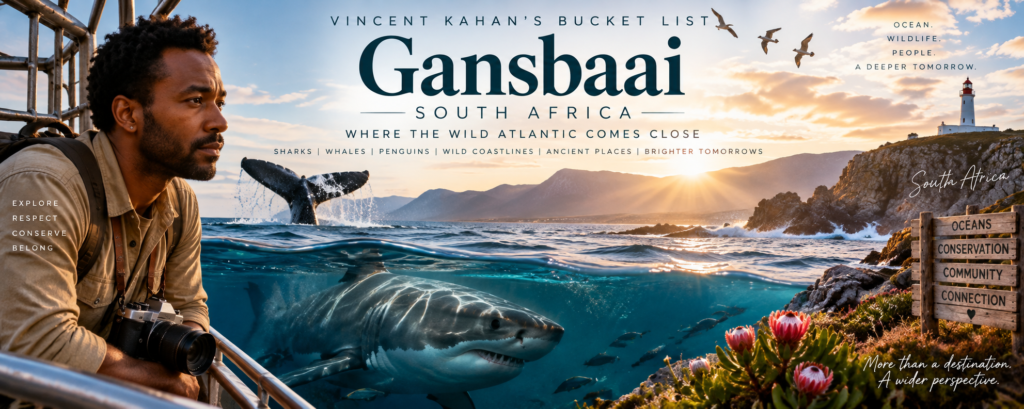
Gansbaai, South Africa: Where the Wild Atlantic Comes Close
A Vincent Kahan Bucket List Journey
There are places you visit because you already know what you want to see.
Then there are places that quietly dismantle the list.
Gansbaai, on South Africa’s Western Cape, has spent years associated with one extraordinary animal: the great white shark. Its waters became internationally famous through shark research, documentaries and cage-diving expeditions, earning the region a reputation as one of the great places on Earth to encounter sharks.
But arrive here looking only for a great white and you may miss the larger story swimming around you.
That is precisely why I want to go.
Gansbaai is not one animal.
It is ocean and limestone. Fynbos and fishing boats. Whales moving through Walker Bay. African penguins travelling between feeding grounds and breeding colonies. Cape fur seals gathering offshore. Dolphins appearing where nobody scheduled them to appear. Sharks moving through an ecosystem whose rules we are still trying to understand.
And beneath the cliffs are caves where humans watched this same coastline thousands upon thousands of years before anyone thought of putting Gansbaai on a bucket list.
So I would begin with the sharks.
But I wouldn’t end with them.
🦈 Into the Water at Kleinbaai
Early morning at Kleinbaai Harbour seems like the right place to begin.
The boats are preparing to leave. Equipment is being checked. People are talking about sharks.
I’d probably be watching the seabirds.
Eventually, though, there would be no avoiding that cage waiting alongside the boat.
Gansbaai remains one of South Africa’s best-known shark-diving destinations, but there is an important distinction for today’s traveller: this should be approached as shark cage diving, not as a guaranteed great white shark encounter.
Wild animals do not honour tourism brochures.
The region’s great whites have experienced significant changes in their distribution, while bronze whaler sharks, also known as copper sharks, have become prominent participants in Gansbaai’s shark encounters. Recent local expedition reports regularly document bronze whalers alongside other wildlife such as Cape fur seals, rays, dolphins, whales and African penguins.
That makes the experience more interesting to me, not less.
I’d want to go with people who put marine biology beside adventure, explaining the animals rather than simply producing an adrenaline rush.
Then comes the moment.
Mask on.
Cold Atlantic water.
Hands around the rail.
And somewhere beyond the cage, a shark materializes.
Perhaps a bronze whaler.
Perhaps something else.
The temptation would be to measure the experience by what species appeared.
I think I’d rather measure it by what disappeared.
Fear, perhaps.
Or at least some of it.
Because a shark seen from shore, television or imagination can become a symbol. A shark encountered in its own environment becomes an animal again.
And that difference matters.
🌊 Discover the Greater Dyer Island Ecosystem
Once you’ve looked through the bars of a shark cage, it would be easy to believe you’ve experienced the ocean around Gansbaai.
You haven’t.
Not remotely.
The waters around Dyer Island form an extraordinarily rich marine environment associated with what local ecotourism operators call the Marine Big 5: whales, sharks, dolphins, Cape fur seals and African penguins.
I would want another day on the water without the cage.
Just watching.
Dyer Island supports important seabird habitat, including African penguins, while nearby Geyser Rock is home to Cape fur seals. Whales and dolphins move through the surrounding waters, and sharks connect yet another part of the ecological web.
Nothing here really exists alone.
That’s the revelation I’d be looking for.
A penguin disappearing beneath the surface isn’t simply a charming bird going for a swim. It is a marine predator heading out to find food.
A seal isn’t merely basking on a rock. It is part of the food web.
A shark isn’t a villain arriving from somewhere outside the story.
It was already in the story.
So were we.
The more time I spent around Dyer Island, the less interested I’d become in collecting five sightings.
I’d want to understand the connections between them.
🐧 Meet the Survivors at the African Penguin and Seabird Sanctuary
Back on land, there is somewhere I would consider essential.
The African Penguin and Seabird Sanctuary in Gansbaai, operated by the Dyer Island Conservation Trust, rehabilitates African penguins and other seabirds in distress.
Some arrive injured. Others may be oiled, abandoned or otherwise unable to survive without intervention.
This isn’t a wildlife attraction in the conventional sense.
It’s a place you hope eventually has fewer patients.
The African penguin is the only penguin species native to Africa, and its struggle for survival transforms these funny, charismatic birds into something much more consequential.
Here, conservation becomes individual.
Statistics become birds.
A population decline becomes one animal being fed, treated, monitored and, whenever possible, returned to the wild.
I think this might be one of the places where I stay longer than planned.
Not because penguins are adorable, although they have certainly weaponized adorability with remarkable efficiency.
I’d stay because rehabilitation is one of conservation’s least glamorous miracles.
Somebody has to clean.
Somebody has to feed.
Somebody has to monitor.
Somebody has to show up again tomorrow.
Saving wildlife isn’t always standing dramatically on the bow of a boat.
Sometimes it’s preparing another meal.
🐋 Stand Still at De Kelders
After boats, cages and conservation centres, I would need a quieter encounter with the ocean.
De Kelders provides it.
The limestone cliffs overlooking Walker Bay offer exceptional land-based whale watching when whales are present, particularly during the seasonal movements of southern right whales.
No boat required.
No timetable except the whale’s.
I’d find somewhere overlooking the water and wait.
There is something important about waiting for wildlife.
Modern travel encourages us to schedule encounters:
09:00 sharks.
13:00 penguins.
15:30 whales.
Nature has apparently declined access to our calendar.
A whale may appear.
It may not.
Perhaps there will only be a patch of disturbed water, followed by the unmistakable curve of a back.
Perhaps a southern right whale will linger close enough to shore to make everyone along the cliffs fall silent.
Or perhaps the bay will remain empty.
I’d still stay awhile.
Because after spending a morning looking into the ocean, this is where I’d let the ocean come to me.
🪨 Walk Back Through Time at Klipgat Cave
Near De Kelders, the coastline opens another door.
This one leads backwards.
Klipgat Cave, within Walker Bay Nature Reserve, preserves evidence of human occupation from the Middle and Later Stone Age. CapeNature describes it as one of South Africa’s remarkable examples of early human habitation.
The cave is reached from the De Kelders side of the reserve, with a boardwalk helping visitors enter a landscape where archaeology and ocean meet.
This would change the journey for me.
Until now, I would have been thinking about Gansbaai primarily as a place of wildlife.
Klipgat introduces another species.
Us.
Imagine standing within the shelter of the cave and looking toward Walker Bay.
Humans stood within this landscape unimaginably long before the lighthouse, fishing harbour, conservation organizations, tour boats or bucket lists.
They knew this coastline differently.
The sea provided food.
Weather mattered immediately.
Knowledge of animals wasn’t recreational.
Survival depended upon understanding place.
I’d resist the temptation to pretend I could know what those distant inhabitants thought while looking across the water.
We don’t need to invent their thoughts.
It is enough to recognize that they looked.
The ocean before us is part of a human story far older than Gansbaai itself.
🌿 Walk the Wild Edge of Walker Bay
Eventually I would want an entire morning with no engine.
Walker Bay Nature Reserve protects a long stretch of coastline between the Klein River estuary and the De Kelders area, combining sandy beaches, rocky limestone formations, coastal vegetation and remarkable ocean views.
This is where the pace changes.
Walk.
Stop.
Look.
Walk again.
Fynbos rewards that kind of attention.
From a distance, the vegetation can seem understated beside the theatrical Atlantic. Up close, the Cape Floristic Region reveals extraordinary botanical diversity.
And once you start noticing the smaller things, the landscape expands.
Flowers.
Insects.
Tracks.
Bird calls.
Lichens on stone.
Wind moving through vegetation.
The distant possibility of a whale offshore.
This is one of my favourite transformations in travel: when a place initially famous for something enormous teaches you to look at something tiny.
Gansbaai may lure people toward the ocean with sharks and whales.
The fynbos asks whether you can notice a flower.
Both encounters count.
⚓ Follow the Coast to Danger Point
Then I would follow the coastline toward Danger Point.
The name doesn’t exactly whisper reassurance.
The lighthouse standing above this treacherous stretch of coast has warned mariners since the late nineteenth century, but the surrounding waters had already written darker chapters of maritime history.
Most famous is the wreck of HMS Birkenhead in 1852 after the troopship struck a submerged rock off the coast. Hundreds died in the disaster.
Standing near the lighthouse would introduce another version of the ocean.
Not habitat.
Not playground.
Not scenic backdrop.
Power.
For generations, people living and travelling along this coast have had to respect weather, reefs, currents and distance.
We sometimes speak about “conquering” oceans, mountains and wilderness.
Places such as Danger Point expose the arrogance hiding inside that word.
Nobody conquers an ocean.
At best, we learn how to travel through it.
🎣 Return to Gansbaai Harbour
My final stop wouldn’t need an admission ticket.
I’d return to the harbour.
Gansbaai is not simply an ecotourism destination. It grew through its relationship with fishing and the sea, and that working coastal identity still matters.
I’d want to watch the ordinary rhythm of boats, people, gulls, equipment and weather.
Tourism has a peculiar ability to turn communities into scenery.
A harbour corrects that.
Boats aren’t necessarily waiting to take visitors somewhere photogenic.
People are working.
Families have histories here.
The ocean provides livelihoods as well as adventures, while conservation creates difficult questions about how marine resources, wildlife, tourism and local economies coexist.
There aren’t tidy answers to all of those questions.
Good.
Travel shouldn’t always leave us with answers.
Sometimes returning home with better questions is the souvenir worth keeping.
🌍 Why Gansbaai Belongs on My Bucket List
I came here, at least in imagination, because of sharks.
That isn’t where I ended.
Gansbaai belongs on my Bucket List because it compresses so many relationships into one relatively small stretch of South African coast.
Predator and prey.
Land and ocean.
People and wildlife.
Tourism and conservation.
Ancient habitation and modern community.
Fear and understanding.
Loss and rehabilitation.
The spectacular and the almost invisible.
You can descend into Atlantic water hoping to see a shark and, days later, find yourself staring at a tiny fynbos flower.
Both moments can rearrange your sense of scale.
And perhaps that is what makes this place extraordinary.
Gansbaai doesn’t merely show you wildlife.
It reveals relationships.
📍 Vincent’s Gansbaai Bucket List
🦈 Shark cage diving from Kleinbaai
Enter the water with an experienced, conservation-minded operator and let the sharks that actually arrive determine the encounter.
🌊 Explore the Dyer Island marine ecosystem
Look beyond a single headline species toward whales, dolphins, seals, sharks, penguins and seabirds sharing one extraordinary marine environment.
🐧 Visit the African Penguin and Seabird Sanctuary
See the painstaking work behind wildlife rehabilitation and learn about the conservation challenges facing African penguins.
🐋 Whale watch from De Kelders and Walker Bay
Trade the boat for the cliffs and allow patience to become part of the wildlife encounter.
🪨 Explore Klipgat Cave
Step into an archaeological landscape preserving evidence of humans who knew this coastline thousands of years before us.
🌿 Walk Walker Bay Nature Reserve
Give the beaches, limestone formations, fynbos, birds and smaller inhabitants of the coast their share of attention.
⚓ Visit Danger Point
Stand beside the lighthouse and consider the maritime history of a coastline that has never surrendered its power to human schedules.
🎣 Spend time around Gansbaai’s working harbour
Remember that this is someone’s home before it is someone else’s destination.
🧭 A Few Notes Before You Go
Wildlife encounters are never guaranteed, and that should be considered part of the experience rather than a failure of it. Shark species and numbers vary, whales are seasonal, weather changes quickly and sea conditions can alter or cancel marine excursions.
For shark and whale excursions, choose operators that emphasize qualified guides, wildlife welfare, education, research and conservation rather than guaranteed spectacle.
Walker Bay Nature Reserve is protected by CapeNature, and access conditions, conservation fees and opening hours can change. Klipgat Cave is accessed through the De Kelders entrance and involves a boardwalk plus some uneven terrain, so checking current conditions before setting out is sensible.
The African Penguin and Seabird Sanctuary welcomes visitors, and its conservation work continues year-round. Visiting directly supports something more enduring than a photograph: the possibility of another bird returning to the ocean.
And leave room in the itinerary.
Gansbaai seems exactly the sort of place where the unscheduled hour may become the one you remember.
🌊 Vincent’s Closing Reflection
Maybe the wrong question is:
What did you see?
A shark?
A whale?
A penguin?
A cave?
A lighthouse?
Those answers turn a journey into an inventory.
I’d rather come home from Gansbaai asking something different:
What did I begin to understand?
That a shark belongs to an ecosystem before it belongs on a bucket list.
That conservation is often repetitive, patient work performed far from applause.
That humans have been watching this coastline for thousands of years.
That the sea can sustain a community and threaten it.
That a penguin, whale, shark, seal, seabird, fisherman, scientist and traveller may occupy very different places within the same landscape, yet none exists entirely outside the others.
Perhaps that’s what I would carry home from Gansbaai.
Not the moment a shark appeared beside the cage.
The moment I understood that the shark was never the whole story.
It was the door.
And Gansbaai was everything waiting on the other side.
More to Explore
The Beautiful Gansbaai – Gansbaai has a world of attractions for the marine enthusiast and nature lover. Besides the thrill of diving with sharks, there are a number of sea and island activities that will inspire the sea-farer in everyone. For nature enthusiasts and beachcombers, Gansbaai has plenty of on-land activities that cater to couples and families alike.
Gansbaai Tourism – Begin planning your visit or vacation.
White Shark Projects – About the area, famous for Great White Sharks.
Wikipedia – Gansbaai, according to the online encyclopedia.
Discover More
World Wildlife Day – March 3 is World Wildlife Day. It is a United Nations International Day to celebrate all the world’s wild animals and plants and the contribution that they make to our lives and the health of the planet.
Day of the Liberation of South Africa – Day of the Liberation of Southern Africa is observed on March 23 every year.
World Photography Day – August 19th join the celebration, and have your photos featured!

Vincent Kahan brings a deep, grounded perspective to Go Cybernaut’s travel section as the Africa Travel Writer.
With roots in both journalism and anthropology, he explores destinations with care, curiosity, and cultural sensitivity—seeking stories that stretch beyond the safari brochure.
His writing blends lived experience with poetic precision, often spotlighting local voices, heritage sites, and the resilient rhythms of everyday life across the continent.
Have you ever visited a mountain, lake, valley, or sacred-feeling landscape that made you move more slowly?
Come wander with us through more Go Cybernaut Bucket List destinations, where every journey is chosen for curiosity, care, and wonder.
Inspired by the 2026 Travel 365 Desk Calendar from Papp Publishing.
🌟 Support the Go Cybernaut Constellation
Go Cybernaut is a soft place for curiosity, music, discovery, and storytelling. Every article, playlist, and celebration is created to help people feel a little less alone and a little more inspired.
If something here brightened your day, you can help keep the constellation shining:
📚 Visit the Cybernaut Bookstore
🎶 Explore our curated playlists
🛍️ Visit & Shop on Market Street
Every visit, share, and small contribution helps this creative space continue to grow.
Thank you for being part of the journey. 🌿
Go Cybernaut is a human-led cultural discovery and celebration publisher, created by Gayle Olson with an AI-supported editorial constellation. Through accessible guides, playlists, stories, and seasonal celebrations, it creates a soft place to land for curious people seeking connection, delight, and discovery.
Go Cybernaut is an infotainment network created by one human and a constellation of AI personalities to bring a variety of resources and media to you!
Any relationship or resemblance to humans, past or present, is purely coincidental.
