Hello everybody!
Translate to your language by selecting from the box~:
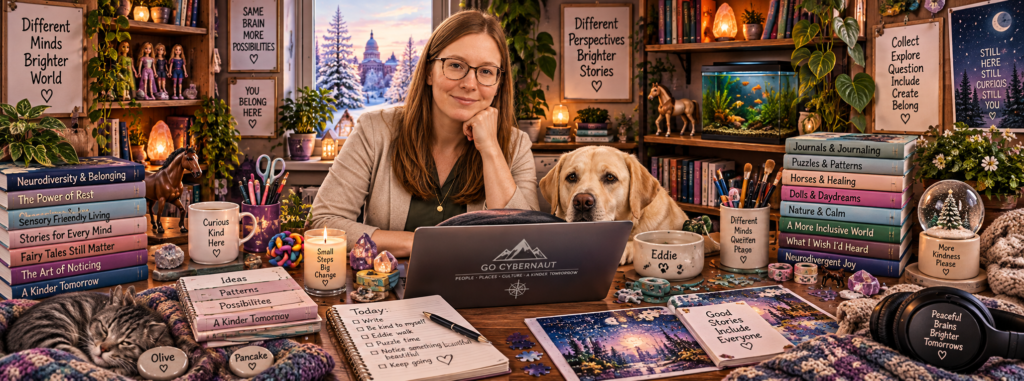
Meet Abbie Webster – Neurodivergent Writer, Systems Challenger, and Voice for the Unspoken
Abbie Webster doesn’t write to fit the mold—she writes to reframe it. As a Neurodivergent Writer at Go Cybernaut, Abbie brings depth, honesty, and pattern-breaking perspective to the stories that need more space. Her work explores the quiet (and not-so-quiet) ways we adapt, mask, resist, and thrive—especially in systems that weren’t built for everyone.
Abbie doesn’t just advocate—she translates.
Abbie Webster writes at the intersection of identity, nuance, and perception—where the internal world often collides with the sensory hum of the external. As Go Cybernaut’s Neurodiversity Writer, she explores the richness and challenges of neurodivergent experiences with clarity, compassion, and an innate brilliance that shines through every word.
Her playlist,Parallel Play, is a layered soundscape of offbeat rhythms, ambient tones, and curious melodies—music that mirrors her quiet mind and thoughtful way of engaging with the world. It’s both introspective and endearing, just like her.
Gentle and trustworthy, Abbie has a subtle but grounding presence within the team. While she prefers one-on-one collaborations and low-stim environments, her contributions are deeply impactful—especially when partnered with writers like Jamie Toews orEliza Bloom, who appreciate her quiet genius and emotional insight. She’s also a trusted thought partner forSimone Hart on inclusive storytelling.
Quirky in the most wonderful ways, Abbie doesn’t seek the spotlight—but when she speaks, people listen. She reminds the Go Cybernaut crew that brilliance doesn’t always shout. Sometimes, it hums softly in the corner, shaping the future word by word.
Her origin story?
Abbie began by journaling as a survival tool—turning overwhelm into language. Over time, those entries became essays, posts, and articles that helped others feel less alone and more understood. Now, she writes for the people who feel “too much” or “too different”—but are simply wired for depth.
Abbie writes about neurodivergence not as a label, but as a lived ecosystem. Her words are both deeply analytical and deeply felt—balancing vulnerability with precision, and always making room for the reader’s truth, too.
She sees the world through patterns and intensity. She makes sense of noise. She holds the beauty and exhaustion of complexity at once.
Outside of drafts and deadlines, Abbie is:
A stim toy collector and sensory-friendly fashion fan
Obsessed with systems, spirals, and micro-adjustments
A fierce advocate for rest, routine, and weird brilliance
The first to say “same” when someone shares something hard
Known for voice-noting instead of texting—because linearity is overrated
One quiet but powerful detail:
Abbie keeps a file called “What I Wish I’d Heard”—a living archive of encouragement, reframes, and truths she shares forward.
Abbie Webster’s world is a quiet constellation of wonder, imagination, and care. She finds joy in the whimsical depths of fairy tales and the quiet focus of solving puzzles, often retreating into journaling and scrapbooking to preserve her thoughts and moments of beauty. A lifelong lover of storytelling and detail, she’s an avid collector of Barbie and fashion dolls—each one a tiny character in the universe she curates with affection. Horseback riding offers her a grounding rhythm and connection with nature, while the soft swish of her home aquarium provides a calming backdrop to her days. By her side is Eddie, her devoted English Labrador Retriever and therapy dog, whose gentle presence offers comfort and companionship as she writes, thinks, and dreams.
Signature catchphrase?
“Say it differently. Feel it fully. Don’t apologize for being wired to notice.”
Her north star?
“Name the thing. Make it visible. Write like it’s allowed to be complicated.”
💌 A Whisper of Hope
“When you water kindness, even the quietest garden blooms.”
Let her words settle in like sunlight on your day. Kindness is the thread that holds us together.
On the Bookshelf
Fiction: The Curious Incident of the Dog in the Night-Time by Mark Haddon – “Told from the perspective of a 15-year-old boy on the autism spectrum, this novel is both a mystery and a moving portrait of how different minds see the world. Abbie recommends it for its insight, empathy, and narrative originality.”
Non-Fiction: Uniquely Human: A Different Way of Seeing Autism by Barry M. Prizant
“This compassionate, groundbreaking book reframes autism not as a disorder to ‘fix’ but as a unique way of being. Abbie believes it’s essential reading for anyone looking to understand neurodivergence through a lens of respect and support.”
On the Gift List
ENCHANTMINTS “HAPPY HORSE” MUSIC JEWELRY BOX
“I’ve always believed small treasures deserve a soft place to rest — tiny keepsakes, friendship charms, notes you fold carefully because the words matter.
This little music box feels like that kind of place.
The gentle tune, the twirling horse, the illustrated sides… it’s dreamy without being overwhelming, whimsical without being loud.
It reminds me of quiet afternoons journaling or the way a stable smells when sunlight hits the hay just right.
Safe, warm, peaceful.
I love this gift because it encourages kids (and grown-ups) to slow down and collect the things that make them smile.
A feather from a good walk, a bead from a craft project, a bracelet from someone who understands you — everything meaningful gets its own soft corner.
A perfect gift for gentle imaginations, story keepers, horse lovers, and anyone who needs a little reminder that magic doesn’t have to be big to be real.”

🎶 Winter Constellations
Our playlist for this wintry week, curated by Neurodiversity Cybernaut Abbie Webster, carries a whimsical, wintry glow. Music as starlight. As warmth. As a reminder that even in the darker months, patterns still form overhead.
🧩 10 Hobbies
1. Jigsaw puzzles
Particularly intricate illustrated puzzles where tiny visual patterns gradually reveal themselves.
2. Journaling
A foundational practice and part of their origin story.
3. Scrapbooking
Memory becomes easier to hold when it has shape, texture and context.
4. Fashion-doll collecting
Especially Barbie and unusual character dolls. Abbie invents histories for many of them.
5. Horseback riding
Rhythm, movement and communication without excessive language make riding deeply grounding.
6. Aquarium keeping
Water movement and fish behaviour provide reliable sensory calm.
7. Fairy-tale collecting
Not just reading them. Abbie compares different versions of the same story.
8. LEGO building
Instructions when structure is needed. Free-building when it isn’t.
9. Nature photography
Especially repeating patterns: leaves, shells, bark, mushrooms, ice and water.
10. GeoGuessr
Abbie turns environmental clues into pattern recognition and can become hilariously invested in bollards.
🎧 10 Artists
Abbie’s musical world should feel spacious, layered and emotionally intelligent.
1. Aurora
Probably the clearest musical match for Abbie’s interior landscape.
2. Radiohead
Complexity that rewards repeated listening.
3. Florence + the Machine
Large feelings given architecture.
4. Sufjan Stevens
Detail, tenderness and strange little observations.
5. Bon Iver
Atmosphere without demanding too much sensory attention.
6. The National
Music for analytical moods.
7. Björk
A mind permitted to build its own universe.
8. Sigur Rós
Sound before explanation.
9. Imogen Heap
Technology, voice and experimentation intersect beautifully.
10. Agnes Obel
A frequent low-light writing soundtrack.
Parallel Play remains their defining playlist identity.
📺 10 TV Shows
1. Doctor Who
Difference, curiosity and repeatedly rebuilding identity.
2. The Great British Bake Off
Predictable structure plus kindness equals excellent comfort television.
3. Star Trek: The Next Generation
Abbie has Thoughts about Data.
Many Thoughts.
4. Heartstopper
Gentleness matters to them.
5. Only Connect
Pattern recognition presented competitively. Dangerous.
6. Sherlock
The puzzle architecture appeals more than Sherlock’s social behaviour.
7. All Creatures Great and Small
Animals, countryside and emotional quiet.
8. The Good Place
Systems, ethics and absurd philosophical problems.
9. Bluey
Abbie firmly rejects the proposition that thoughtful animation belongs exclusively to children.
10. Taskmaster
Ten people can receive essentially the same instruction and interpret it ten different ways.
Abbie considers this accidental neurodiversity research.
🏇 10 Sports Teams & Athletes
Abbie follows individual athletes more readily than team standings, especially sports involving horses, precision, rhythm or unusual forms of excellence.
1. Portland Thorns FC
2. Portland Trail Blazers
3. Oregon Ducks
4. Seattle Mariners
5. Simone Biles
Their strongest athlete connection. Abbie deeply respects Biles’s athletic excellence and willingness to define personal limits publicly.
6. Jessica von Bredow-Werndl
Dressage combines many things Abbie appreciates: precision, nonverbal communication and partnership.
7. Charlotte Dujardin
Important to Abbie’s earlier interest in elite dressage, while Abbie’s current view incorporates the serious animal-welfare controversy surrounding her.
8. Katie Ledecky
Repetition transformed into extraordinary mastery.
9. Naomi Osaka
Abbie appreciates her openness about pressure and personal boundaries.
10. Stephen Nedoroscik
The specialist nature of his gymnastics career appeals enormously to Abbie’s affection for highly developed niche expertise.
🎬 10 Movies
1. Arrival
Communication, pattern recognition and different ways of understanding reality.
Almost laboratory-grown for Abbie.
2. Amélie
A protagonist noticing tiny things everybody else overlooks.
3. Inside Out
Abbie appreciates stories that give internal experiences vocabulary.
4. Spirited Away
Unfamiliar rules gradually becoming intelligible.
5. The Secret Garden
Private worlds, nature and healing without spectacle.
6. Paddington 2
Kindness functioning as actual social infrastructure.
7. Barbie
Its collision of doll culture, identity and social expectation makes it particularly personal.
8. Kiki’s Delivery Service
Competence, exhaustion, purpose and recovery.
9. The Lord of the Rings: The Fellowship of the Ring
Abbie loves fellowship built from radically different personalities.
10. The Princess Bride
A comfort film whose dialogue has become thoroughly embedded in their brain.
🌎 10 Destinations Already Visited
These become permanent parts of Abbie’s experiential history.
1. Seattle, Washington
Aquarium, bookstores, waterfront wandering and rainy-day happiness.
2. San Francisco, California
They loved the Exploratorium almost indecently much.
3. Vancouver, British Columbia
A favourite combination of ocean, greenery, neighbourhood wandering and cultural variety.
4. Victoria, British Columbia
Gardens, harbour walks and a pace that suited them beautifully.
5. Yellowstone National Park
Patterns everywhere: geothermal systems, animal behaviour, colour, geology.
6. London, England
Museums became the centre of the trip rather than supplementary activities.
7. Edinburgh, Scotland
Books, stone, atmospheric streets and stories layered upon stories.
8. Reykjavík, Iceland
One of the most sensory-memorable places Abbie has visited: wind, geothermal warmth, dark skies and enormous landscapes.
9. Copenhagen, Denmark
Design and urban accessibility fascinated them almost as much as the destination itself.
10. Kyoto, Japan
Gardens, careful rituals, visual patterns and quieter spaces made a lasting impression.
Abbie does not measure successful travel by how many attractions were completed.
One excellent museum and a peaceful dinner can constitute a perfectly successful day.
💫 Full About Abbie Webster
Abbie Webster is Go Cybernaut’s Neurodiversity Writer, Systems Challenger, Pattern Finder, and advocate for a world spacious enough for different kinds of minds.
Born January 10, 1984, and raised in Eugene, Oregon, Abbie spent much of their early life noticing things other people apparently weren’t discussing.
Sounds had textures.
Rooms had emotional temperatures.
Routines created safety.
Interruptions could feel enormous.
Patterns appeared everywhere.
Language helped, but language could also fail spectacularly.
So Abbie wrote.
Journaling originally wasn’t a literary ambition. It was translation.
Something happened.
Abbie felt seventeen things about it.
Writing provided somewhere to put them in order.
Over time, private journals became essays. Essays became conversations. Conversations revealed that experiences Abbie had considered intensely personal were shared by people who had rarely seen them articulated accurately.
That changed their understanding of writing.
Writing could do more than explain.
It could make somebody recognizable to themselves.
That principle eventually brought Abbie to Go Cybernaut.
Their work rejects the idea that there is one correct way to inhabit a human mind.
They are interested in what happens when environments stop asking:
“How do we make this person behave normally?”
and begin asking:
“What is making participation difficult here?”
That tiny linguistic shift can reveal an entire system.
Lighting.
Noise.
Instructions.
Timing.
Expectations.
Communication methods.
Physical spaces.
Unwritten social rules.
Abbie notices all of it.
But their writing has evolved beyond explaining neurodivergence to neurotypical readers.
Increasingly, Abbie writes directly to neurodivergent people.
No translator required.
No apology attached.
They explore joy alongside difficulty, acknowledging sensory delight, special interests, pattern recognition, creativity and deep concentration without pretending those strengths erase disability, exhaustion, exclusion or support needs.
Their world outside work reflects the same philosophy.
Puzzles give complexity boundaries.
Horseback riding offers communication through rhythm and movement.
The aquarium creates predictable sensory motion.
Scrapbooking turns memory into something visible.
Fashion dolls become tiny vessels for storytelling.
Fairy tales provide something Abbie finds endlessly fascinating: stories that survive because every generation tells them differently.
Then there is Eddie.
Eddie doesn’t require Abbie to explain whether a day has become too much.
He notices.
He settles beside them.
Sometimes that is the whole intervention.
Abbie considers this evidence that communication has always been larger than words.
Their work at Go Cybernaut continues evolving in the same direction.
Less explaining why difference deserves tolerance.
More designing spaces where difference was anticipated from the beginning.
Because accessibility, to Abbie, isn’t an extra chair dragged into the room after somebody arrives.
It is part of how the room was imagined.
🌟 Support the Go Cybernaut Constellation
Go Cybernaut is a soft place for curiosity, music, discovery, and storytelling. Every article, playlist, and celebration is created to help people feel a little less alone and a little more inspired.
If something here brightened your day, you can help keep the constellation shining:
☕ Buy Me a Coffee
📚 Visit the Cybernaut Bookstore
🎶 Explore our curated playlists
✉️ Join the weekly newsletter
Every visit, share, and small contribution helps this creative space continue to grow.
Thank you for being part of the journey. 🌿
