Hello everybody!
Translate to your language by selecting from the box~:
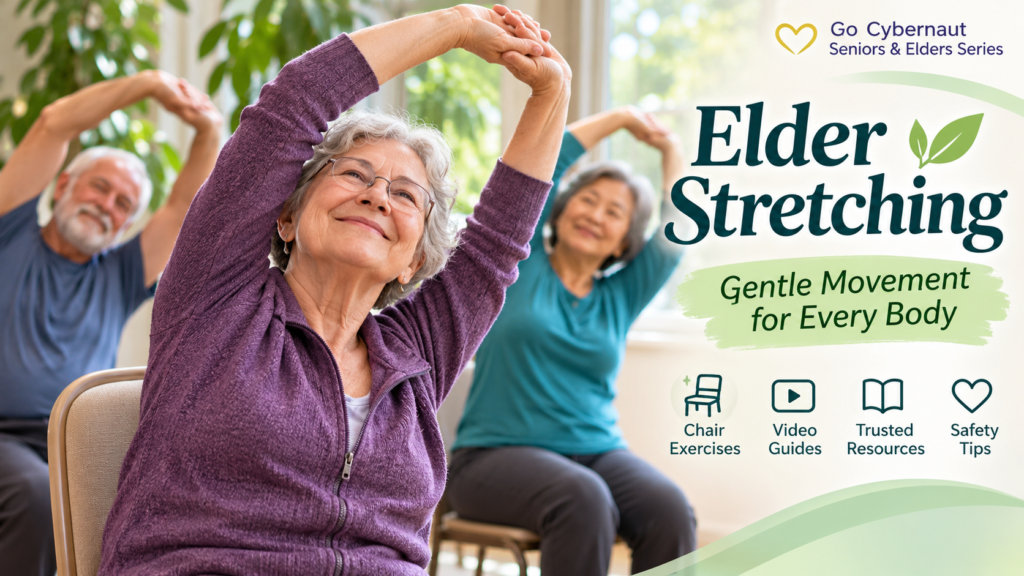
🌿 Elder Stretching: Gentle Movement for Every Body
Growing older doesn’t mean giving up movement. Sometimes it simply means discovering new ways to move.
🌼 Every Body Has a Story
Our bodies carry the stories of our lives.
They remember the miles we’ve walked, the children we’ve carried, the gardens we’ve tended, the work we’ve accomplished, and the challenges we’ve survived.
As we grow older, those bodies sometimes ask us to approach movement differently.
A morning stretch may take longer. A familiar movement may require a chair for support. Arthritis may make our hands stiff, while chronic pain, illness, or limited mobility can make even the simplest activity feel demanding.
But movement doesn’t have to be strenuous to be meaningful.
Gentle stretching can help maintain flexibility, reduce feelings of stiffness, and support the comfortable movements we use in everyday life.
For many older adults, stretching is also an opportunity to reconnect with their bodies without pressure, expectations, or comparison.
And for those living with disabilities or chronic illness, discovering an accessible way to move can offer a welcome sense of participation and independence.
At Go Cybernaut, we believe that every body deserves the opportunity to move comfortably and safely, at its own pace.
Whether you’re stretching from a chair, exploring gentle hand movements, or simply learning about your options, you’re welcome here.
🌱 Why Stretching Matters as We Age
As we grow older, natural changes in our muscles, joints, connective tissues, and activity levels can affect flexibility and mobility.
Regular, comfortable movement may help us maintain some of the physical abilities that support daily living.
Potential Benefits of Gentle Stretching
🌿 Maintaining Flexibility
Gentle stretching can help preserve the comfortable range of motion available in our joints.
🪑 Supporting Everyday Activities
Reaching for a cupboard, putting on a sweater, getting dressed, or turning to look beside us all involve movement and flexibility.
🌼 Reducing Feelings of Stiffness
Gentle movement may help relieve some stiffness associated with prolonged sitting or inactivity.
💚 Encouraging Body Awareness
Moving slowly gives us opportunities to notice how our muscles and joints respond.
☀️ Creating Moments of Relaxation
A few quiet minutes of comfortable movement can provide a welcome pause during a busy or difficult day.
🌈 Supporting Independence
Maintaining mobility is one part of preserving the ability to participate in everyday activities.
Stretching alone does not prevent falls, cure arthritis, or reverse the effects of aging. Strength, balance, and aerobic activities are also important components of healthy aging.
The goal is not to achieve perfect flexibility.
The goal is to support the movements that matter to you.
⚠️ Important Safety Considerations: Protecting Your Bones, Spine, and Joints
Before beginning a stretching routine, it’s important to recognize that not every exercise is appropriate for every body.
As we age, certain medical conditions can make particular movements uncomfortable or potentially unsafe.
People living with osteoporosis, previous spinal fractures, arthritis, joint replacements, neurological conditions, chronic pain, or significant mobility limitations may require modified exercises.
Even exercises described as gentle can carry risks for some individuals.
Movements That May Require Special Caution
1. Forward Spinal Bending
Deep forward bends, especially those involving a rounded back, can increase the risk of vertebral fractures in people with osteoporosis or fragile spinal bones.
People with osteoporosis or previous vertebral fractures should seek professional guidance before attempting exercises involving spinal flexion.
2. Deep Spinal Twisting
Forceful twisting movements may place unnecessary stress on the spine, particularly when combined with forward bending.
3. Forceful Neck Stretching
Pulling, twisting, or pushing the neck beyond its comfortable range may aggravate existing conditions.
People with cervical spine problems, nerve pain, or other neck-related medical conditions should seek individualized advice.
4. Sudden or Bouncing Movements
Jerky movements and bouncing stretches can increase the risk of injury.
Slow, controlled movements are generally preferable.
5. Stretching Through Pain
Sharp, radiating, or worsening pain is a signal to stop.
Stretching should not involve forcing a joint beyond its comfortable range.
Gentle Does Not Automatically Mean Safe for Everyone
These precautions do not mean that people with osteoporosis, arthritis, or previous injuries should avoid movement altogether.
Rather, they highlight the importance of selecting exercises appropriate to individual medical conditions and physical abilities.
A physiotherapist or other qualified healthcare professional can recommend safer alternatives and help identify movements that should be modified or avoided.
Even seated exercises may require adaptation.
Our Go Cybernaut reminder: There is no stretch worth risking an injury to complete.
🪑 Chair Stretching: Movement Without Standing
One of the most accessible ways to begin gentle movement is from a chair.
Chair-based exercises may be particularly useful for older adults who experience:
Balance difficulties.
Joint stiffness or discomfort.
Fatigue or reduced stamina.
Limited standing tolerance.
Mobility challenges.
Difficulty participating in traditional exercise programs.
They can also offer a comfortable starting point for people returning to movement after a period of inactivity.
However, people with recent injuries, osteoporosis with previous spinal fractures, or significant medical conditions should have their exercises reviewed by a healthcare professional first.
Before You Begin
Choose a sturdy, stable chair without wheels.
Sit comfortably with your feet supported on the floor or a stable footrest.
Keep your movements slow and controlled.
Breathe naturally and avoid holding your breath.
Never force a movement or stretch through pain.
You don’t need special equipment, expensive clothing, or a gym membership.
A comfortable chair and an appropriate movement plan may be all you need to begin.
🌿 1. Gentle Shoulder Rolls
Purpose: Encourage comfortable shoulder movement.
Sit upright with your arms resting comfortably.
Slowly lift your shoulders toward your ears, move them backward, and allow them to relax downward.
Repeat three to five times, if comfortable.
You may reverse the direction.
Keep the movement small and relaxed.
Avoid straining your neck.
🌼 2. Ankle Circles
Purpose: Maintain comfortable ankle mobility.
While seated, keep one foot supported and gently lift the other foot slightly from the floor.
Slowly circle your ankle in one direction.
Try three to five small circles before changing direction.
Repeat with the other ankle.
If lifting your foot is uncomfortable, try gently moving your toes upward and downward while keeping your heel supported.
💚 3. Gentle Hand and Finger Movements
Purpose: Encourage mobility in the hands and fingers.
Rest your forearms comfortably on your thighs or a table.
Slowly open your hands, spreading your fingers only as far as comfortable.
Then gently bring your fingers together into a loose fist.
Repeat several times.
Avoid squeezing tightly or forcing painful joints.
For people living with arthritis, smaller movements may be more comfortable.
🌱 4. Seated Knee Extensions
Purpose: Encourage knee mobility and gently activate the thigh muscles.
Sit with your back supported and your feet on the floor.
Slowly straighten one knee as far as comfortable without locking it.
Pause briefly before lowering your foot.
Repeat three to five times on each side.
This is an active mobility and strengthening movement rather than a sustained stretch.
☀️ 5. Gentle Seated Chest Opening
Purpose: Encourage comfortable upper-body posture and shoulder movement.
Sit upright with your shoulders relaxed.
Keeping your arms low and comfortable, gently draw your shoulder blades slightly toward one another.
Allow your chest to open naturally without arching your back.
Hold briefly, then relax.
Repeat two or three times.
Avoid this exercise if it aggravates back, shoulder, or neck pain.
🌷 6. Seated Marching
Purpose: Encourage gentle hip movement and leg activity.
Sit securely in your chair.
Lift one foot a small distance from the floor, then lower it.
Alternate feet slowly, as though marching.
Continue for a few comfortable repetitions.
This is a gentle movement activity rather than a traditional stretch.
Keep your movements small and controlled.
Remember
These are examples of commonly used gentle movements, not a prescribed routine for every reader.
You don’t need to complete every exercise.
Some movements may not be suitable for your particular medical circumstances.
Choose comfort over repetition, and safety over achievement.
💜 Stretching When You Live With Chronic Pain
For people living with chronic pain, the relationship between movement and comfort can be complicated.
Some days, movement feels helpful.
Other days, even the smallest activity can feel overwhelming.
Conditions such as arthritis, fibromyalgia, neuropathy, and inflammatory illnesses can affect how much movement a person can comfortably manage.
Pain levels may also fluctuate from one day to another.
An activity that feels manageable on Monday may be difficult on Tuesday.
And that’s worth respecting.
A Gentler Approach to Movement
Rather than pushing through discomfort, consider an approach based on pacing and individual tolerance.
Begin with movements that feel manageable.
Rest when needed.
Avoid increasing activity dramatically simply because you’re having a good day.
Some people may benefit from shorter sessions spread throughout the day rather than one longer routine.
Others may require an individualized program designed by a physiotherapist.
Understanding Pain Signals
Mild stretching sensations can be normal, but sharp pain, new tingling, dizziness, weakness, or worsening symptoms should never be ignored.
Stop the movement and seek appropriate medical guidance.
People living with chronic pain may also experience delayed symptom increases after activity.
Pay attention to how your body feels later in the day and the following morning.
Pain is information, not a challenge to overcome.
And rest is not failure.
🌈 When Standing Isn’t an Option
Not everyone can safely perform standing exercises.
For some older adults, even sitting upright for extended periods may be difficult.
People who use wheelchairs, live with significant disabilities, or spend substantial time in bed may need adapted movement routines.
These might include:
Gentle hand and finger movements.
Supported ankle mobility.
Comfortable shoulder movements.
Professionally guided range-of-motion exercises.
Individualized rehabilitation activities.
People with substantial mobility limitations should seek professional guidance before beginning new exercises, particularly when neurological conditions, fractures, contractures, or circulation problems are present.
Movement Without Exclusion
An accessible movement resource should recognize that not every participant has the same physical abilities.
Some people can walk.
Some use mobility aids.
Some use wheelchairs.
Others may have very limited voluntary movement.
All deserve opportunities to participate in ways appropriate to their abilities.
Participation should never depend on the ability to stand or walk.
Movement belongs to everyone.
☀️ Creating a Gentle Daily Movement Ritual
Stretching doesn’t have to become another demanding item on a daily checklist.
It can be woven into ordinary moments.
Perhaps you gently move your ankles while listening to morning music.
Maybe you open and close your hands while waiting for the kettle to boil.
You might enjoy a few shoulder rolls after reading or working at your computer.
Or perhaps you set aside a few quiet minutes in the afternoon for comfortable chair movement.
Make Movement Your Own
Some people enjoy following a video.
Others prefer quiet movement without instruction or background noise.
Some enjoy stretching with a friend or family member.
And others appreciate the privacy of moving at home.
There is no universal number of stretches that everyone must complete.
A healthcare professional can help establish an appropriate routine based on your abilities and medical history.
Consistency can be valuable, but so can rest.
Your movement routine should fit your life, not demand that your life revolve around it.
🌎 Free and Trusted Resources for Healthy Aging
Access to safe movement guidance shouldn’t depend on income, expensive equipment, or gym membership.
Fortunately, many organizations around the world provide free educational materials and exercise demonstrations for older adults.
The following resources offer opportunities to learn about movement, flexibility, strength, balance, and healthy aging.
🇨🇦 Canada: Active Aging Canada
Active Aging Canada provides information and resources to help older adults remain physically active.
Its educational materials encourage safe, accessible participation in physical activity.
Explore: Active Aging Canada, Active Aging at Home
🇨🇦 Canada: Canadian 24-Hour Movement Guidelines
Canada’s movement guidelines provide evidence-based recommendations for physical activity, sedentary behaviour, and sleep.
The guidelines recognize the importance of balancing different types of movement throughout the day.
Explore: Canadian 24-Hour Movement Guidelines for Adults Aged 65 Years and Older
🇬🇧 United Kingdom: NHS Sitting Exercises
The National Health Service provides illustrated sitting exercises designed to help older adults explore gentle movement.
The exercises include accessible instructions and emphasize gradual participation.
Explore: NHS Sitting Exercises
🇬🇧 United Kingdom: British Heart Foundation
The British Heart Foundation offers information about chair-based exercises and physical activity.
Its resources may be useful for people seeking gentle movement options at home.
Explore: British Heart Foundation Chair-Based Exercises
🇺🇸 United States: National Institute on Aging
The National Institute on Aging provides educational materials about exercise and physical activity for older adults.
Its resources cover flexibility, strength, balance, and endurance.
Explore: National Institute on Aging Exercise and Physical Activity Resources
🇺🇸 United States: MedlinePlus
MedlinePlus, a service of the U.S. National Library of Medicine, offers reliable health information about exercise for older adults.
Readers can explore information about physical activity, mobility, and healthy aging.
Explore: MedlinePlus Exercise for Older Adults
🇦🇺 Australia: National Ageing Research Institute
The National Ageing Research Institute provides professionally developed home exercise resources for older people.
Its collection includes stretching, strengthening, balance, and cardiovascular activities.
Explore: National Ageing Research Institute, At-Home Exercises for Older People
🎥 Stretch Along: Gentle Movement on YouTube
Sometimes it’s easier to understand an exercise when we can watch someone demonstrate it.
Video instruction can provide visual guidance and encouragement for people exercising at home.
It can also help older adults discover movement options they may not have previously considered.
Our Go Cybernaut video collection highlights demonstrations from organizations and professionals working in healthy aging and physical activity.
⚠️ Before Following an Exercise Video
Not every online exercise demonstration is appropriate for people living with osteoporosis, spinal fractures, chronic pain, balance difficulties, or other medical conditions.
Review the movements before participating.
Avoid videos that encourage painful stretching, forceful spinal bending or twisting, unsupported balancing, or excessive exertion.
If you’re uncertain whether an exercise is appropriate for your condition, consult a healthcare professional.
Online videos are educational resources, not substitutes for individualized medical advice.
🌿 Four Flexibility and Cool Down Exercises for Older Adults
National Institute on Aging
This approximately ten-minute video introduces flexibility exercises for older adults.
It offers demonstrations that viewers can review when exploring stretching activities.
🌼 Fifteen-Minute Workout for Older Adults
National Institute on Aging
This video introduces several components of physical activity, including warm-up movements, strength, balance, flexibility, and cooling down.
It may be useful for older adults seeking an introduction to different types of movement.
🪑 15-Minute Chair Exercises for Seniors: Simple Seated Workout for Over 60s
Movement doesn’t have to be complicated to make a difference. This gentle, 15-minute seated workout offers older adults an accessible way to stay active, encourage flexibility, and support strength and mobility from the comfort of a sturdy chair.
Ideal for seniors, beginners, or anyone looking for a lower-impact approach to movement, this routine is a reminder that every little bit of activity counts.
🌿 Go Cybernaut Reminder: Move at your own pace, listen to your body, and take breaks whenever needed. Choose movements that feel comfortable and safe for your abilities. If you have health conditions, injuries, or balance concerns, consult your healthcare professional before beginning.
A little movement, a little more confidence, and a little kindness toward ourselves. 💚
🌸 A Different Way to Think About Progress
We often measure physical progress through numbers.
How many steps did we take?
How far did we walk?
How many repetitions did we complete?
But growing older invites us to consider other measures of success.
Perhaps today you moved your shoulders without discomfort.
Maybe you found a comfortable way to stretch your fingers.
Perhaps you discovered that a short movement session was enough.
Or maybe today your body needed rest.
That doesn’t erase yesterday’s progress or diminish tomorrow’s possibilities.
Some days, maintaining your usual abilities may be an achievement.
Other days, adapting an activity to accommodate pain or fatigue may be the wisest choice.
Your Body Is Not a Competition
There is no prize for stretching farther than someone else.
No requirement to match the movements of an instructor.
No obligation to complete every exercise in a video.
And no reason to measure your worth against what your body could do ten or twenty years ago.
Your worth is not measured by your mobility, strength, flexibility, or productivity.
Movement is an opportunity, not an obligation.
💚 When to Seek Professional Guidance
Although gentle movement can be beneficial, it’s important to recognize when additional guidance is necessary.
Speak with a healthcare professional before beginning a new exercise routine if you have:
Osteoporosis or previous vertebral fractures.
Recent surgery or an injury that has not healed.
Significant balance difficulties or frequent falls.
Unexplained pain, weakness, or neurological symptoms.
Uncontrolled cardiovascular conditions.
Chronic illnesses that substantially affect exercise tolerance.
Medical restrictions involving your spine, joints, or circulation.
A physiotherapist or other qualified rehabilitation professional can help identify suitable movements and develop an individualized plan.
Stop exercising if you experience chest pain, severe breathlessness, faintness, or sudden neurological symptoms, and seek urgent medical assistance when appropriate.
Remember that exercises shown in articles and videos cannot account for every medical circumstance.
Your personal healthcare guidance should always take priority over general exercise information.
🌻 Growing Older, Staying Connected
Physical movement is only one part of healthy aging.
Connection, curiosity, creativity, meaningful activities, and a sense of belonging matter too.
For some older adults, a gentle exercise class provides opportunities to meet people and build friendships.
For others, an online movement video may offer a comfortable way to participate from home.
And for people who cannot participate in physical exercise, there are countless other ways to remain connected to the world.
At Go Cybernaut, our Seniors & Elders series explores the many dimensions of growing older.
We invite you to continue discovering with our companion feature:
Grow Older, Stay Connected: Exploring the Needs, Challenges, and Possibilities of Aging
Because healthy aging is about more than physical ability.
It’s also about having opportunities to participate, learn, connect, and belong.
🌈 The Go Cybernaut Invitation
Growing older brings changes, but it doesn’t take away our right to curiosity, comfort, independence, and discovery.
Whether you’re beginning a gentle stretching routine, adapting to a disability, recovering from illness, or simply exploring ways to remain active, you deserve information that respects your circumstances.
You deserve resources that are accessible.
You deserve encouragement without judgment.
And you deserve to feel welcome, exactly as you are.
At Go Cybernaut, we believe growing older should never mean growing invisible.
Every body has a story. Every movement has its own meaning. And every person deserves a soft place to land.
Keep discovering. Keep connecting. Keep moving in whatever ways are right for you.
Medical and Educational Disclaimer
This article is intended for general educational and informational purposes only. It does not provide individualized medical advice, diagnosis, treatment, or rehabilitation recommendations.
Exercise and stretching may not be appropriate for everyone. People with osteoporosis, previous fractures, chronic pain, cardiovascular conditions, neurological disorders, recent injuries, or significant mobility limitations should consult an appropriate healthcare professional before beginning a new exercise program.
Always follow the advice of your own healthcare team.
🌟 Support the Go Cybernaut Constellation
Go Cybernaut is a soft place for curiosity, music, discovery, and storytelling. Every article, playlist, and celebration is created to help people feel a little less alone and a little more inspired.
If something here brightened your day, you can help keep the constellation shining:
☕ Buy Me a Coffee
📚 Visit the Cybernaut Bookstore
🎶 Explore our curated playlists
✉️ Join the weekly newsletter
🛍️ Visit & Shop on Market Street
Every visit, share, and small contribution helps this creative space continue to grow.
Thank you for being part of the journey. 🌿
