Hello everybody!
Translate to your language by selecting from the box~:
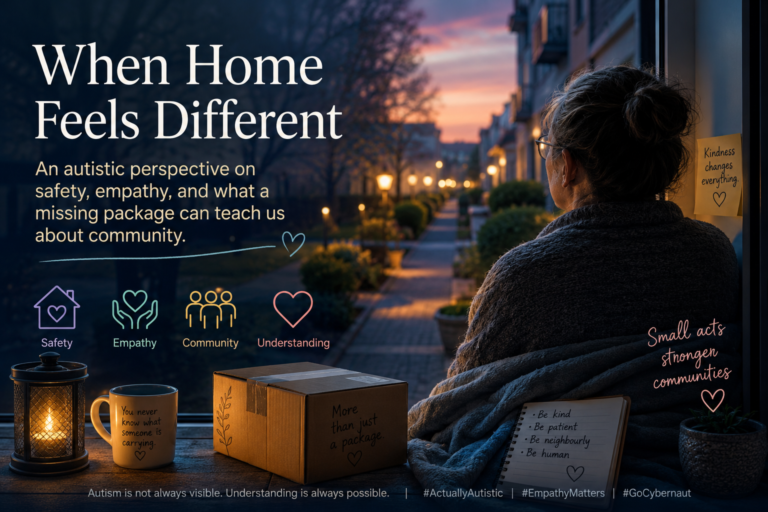
Most stories about missing packages begin with frustration.
Mine began with a feeling I couldn’t quite name.
It wasn’t really about the package.
It was about what disappeared with it.
Like many people, I order things online from time to time. Living with chronic pain means that some days a trip to the shops simply isn’t possible. Home delivery isn’t a luxury for me. It’s one of the ways I remain independent.
One evening, a package was marked as delivered.
It wasn’t there.
What followed would probably look ordinary to many people. I checked the hallway. I looked around the building. I wondered whether the delivery had been made to the wrong apartment. I retraced my steps.
But inside, something much deeper had already begun.
I am autistic.
People often think autism is mostly about communication, routines, or sensitivity to lights and sounds. Those can certainly be part of it. What is less visible is how quickly an autistic nervous system can move from uncertainty to alarm.
A missing package is not simply a missing package.
It becomes questions without answers.
Did I miss something?
Did I make a mistake?
Did someone take it?
Can I still trust the place where I live?
Am I safe?
Those questions don’t arrive one at a time. They arrive together, swirling like autumn leaves caught in a sudden gust of wind. While my mind searched for answers, my body was already reacting. I became nauseous. My stomach cramped. I broke into a sweat. I sneezed repeatedly, something stress often triggers for me. Eventually, I became sick.
None of those reactions were a choice.
They were my nervous system trying to protect me.
For many autistic people, home is more than four walls. It is the place where the outside world finally becomes predictable. It is where the constant work of processing sounds, sensations, conversations, and change can finally ease.
When something unexpected happens there, the feeling can reach far beyond the event itself.
The loss isn’t only an object.
The loss is certainty.
I found myself looking differently at familiar hallways. Wondering who had been there. Wondering whether neighbours had seen anything. Wondering whether I would ever again hear a delivery notification with quite the same confidence.
Perhaps the hardest part was realizing how invisible this experience is.
Someone else might think, “It’s only a package.”
And they would be right.
It was only a package.
But it was also a disruption to the one place my nervous system had always believed was safe.
There is another side to this story that I don’t want to lose.
Even while upset, I kept reminding myself that most people are kind.
I’ve lived here for years. Many neighbours smile, hold doors, collect parcels for one another, and ask how someone is doing. Communities are built from those quiet moments that rarely make the news.
One difficult experience should never erase all the kindness that came before it.
If anything, it reminds me how important good neighbours truly are.
We never fully know what another person is carrying.
The person who seems unusually upset may not be reacting only to the event itself. They may be living with autism, chronic illness, anxiety, grief, or experiences we cannot see.
Kindness often begins long before we know someone’s story.
This experience also reminded me that sensitivity is not something to be ashamed of.
For years I believed I was “too sensitive.”
Now I understand something different.
Sensitivity allows me to notice beauty that others might overlook. It helps me hear comfort in music, find wonder in ordinary places, and care deeply about people and communities.
It also means that hurt sometimes reaches deeper.
The same heart that feels joy intensely can feel loss intensely too.
Perhaps that is simply the price, and the gift, of living with an open heart.
If this story has a lesson, it is not about online shopping.
It is about empathy.
The next time someone seems to be reacting more strongly than we expect, perhaps we can pause before judging.
We cannot always see another person’s nervous system.
We cannot always see their history.
We cannot always see their autism.
But we can always choose kindness.
Sometimes that choice is the very thing that helps another person feel at home again.
🌟 Support the Go Cybernaut Constellation
Go Cybernaut is a soft place for curiosity, music, discovery, and storytelling. Every article, playlist, and celebration is created to help people feel a little less alone and a little more inspired.
If something here brightened your day, you can help keep the constellation shining:
☕ Buy Me a Coffee
📚 Visit the Cybernaut Bookstore
🎶 Explore our curated playlists
✉️ Join the weekly newsletter
🛍️ Visit & Shop on Market Street
Every visit, share, and small contribution helps this creative space continue to grow.
Thank you for being part of the journey. 🌿
