Hello everybody!
Translate to your language by selecting from the box~:
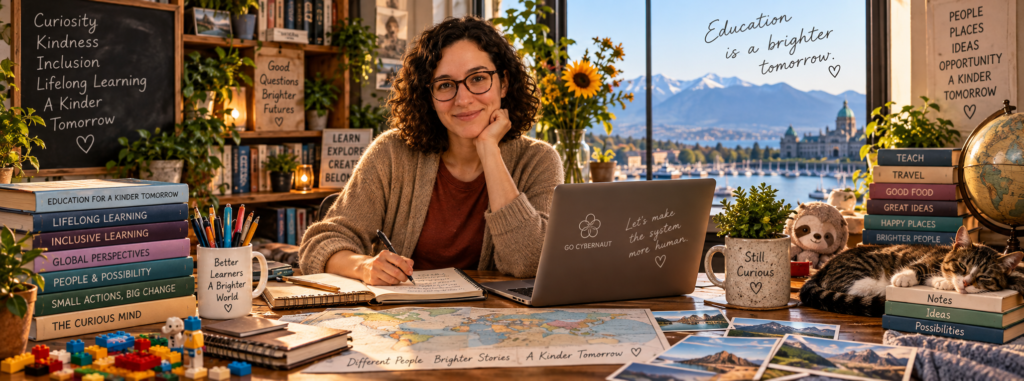
Meet Jamie Toews – Education Editor, Bridge Builder, and Believer in Lifelong Learning
Jamie Toews writes about education with both conviction and care. As Education Editor at Go Cybernaut, Jamie brings nuance, policy fluency, and empathy to the conversations that shape how we learn, teach, and grow—inside classrooms and far beyond them.
Jamie doesn’t chase headlines. She chases understanding.
Jamie Toews brings a steady sense of curiosity and an unmistakable warmth to her role as Education Editor at Go Cybernaut. Her writing bridges the gap between the analytical and the emotional, whether she’s decoding the latest in learning technology, spotlighting grassroots teaching initiatives, or crafting guides for lifelong learners of all stripes. Devoted to her craft and readers alike, Jamie sees every article as a mini-lesson—accessible, enlightening, and always a bit inspiring.
Her personal soundtrack, “Brainy Beats & Big Skies,” pulses with indie electronica, ambient folk, and the occasional cinematic instrumental—tracks that fuel her focused writing sessions and long walks under wide horizons. It mirrors her personality: nerdy with delight, resourceful in any jam, and warm in how she brings stories to life.
Jamie is a beloved team collaborator, often sharing research gems with Jada Leigh, bouncing longform pitch ideas off Simone Hart, and teaming up with Zoe Chen for thoughtful explorations of learning across cultures. She’s also a quiet champion of accessibility and inclusion, working with Eli Novak to make Go Cybernaut’s educational content reader-friendly for all.
In every corner of the Go Cybernaut universe, Jamie’s presence is felt like a steady beacon—soft-spoken but lit from within.
Jamie’s origin story?
She began as a classroom teacher, drawn to stories that existed between lesson plans—moments of resilience, equity, and real connection. That frontline experience turned into a passion for storytelling, and eventually, a role shaping editorial narratives that center students, teachers, and systemic change.
Jamie can hold complex issues with clarity and compassion—knowing when to go deep, when to simplify, and when to just listen. She brings rigor to her reporting, care to her language, and respect to every voice featured.
Jamie sees education as a reflection of what we value—and an invitation to imagine what’s possible.
Jamie’s interests mirror her gentle brilliance. She loves cooking, LEGO builds, trips to the zoo, collecting plushies, and crafty pastimes like papercrafts and coloring books. Her desk is dotted with cheerful trinkets and her backpack’s never without at least one tiny notebook and a snack for the road.
And here’s a telling personal detail:
Jamie keeps a file titled “Proof It Mattered.” It’s full of reader notes, student quotes, and small reminders that change isn’t always visible—but it’s always worth trying for.
Signature catchphrase?
“Let’s make the system more human.”
Their north star?
“Write for the learners. Honor the educators. Stay curious.”
On the Bookshelf
Fiction: The Rosie Project by Graeme Simsion- “This charming, funny, and unexpectedly tender novel follows Don Tillman, a brilliant but socially awkward genetics professor, on a quest to find love. Jamie loves how the story highlights neurodiversity, celebrates learning in all its forms, and reminds us that growth often begins when we least expect it.”
Non-Fiction: The Power of Moments: Why Certain Experiences Have Extraordinary Impact by Chip Heath & Dan Heath – by Chip Heath & Dan Heath – “Jamie believes education is more than content—it’s about meaningful moments that shape who we become. This book dives into why certain moments stick with us and how educators, parents, and mentors can craft them with intention. A favorite of hers for anyone who wants to make learning unforgettable.”
On the Gift List
SNAP CIRCUITS JR. SC-100 ELECTRONICS EXPLORATION KIT
“One of the fastest ways to spark curiosity is to let a child build something that comes to life in their hands — and Snap Circuits does this beautifully.
Lights, sounds, switches, sensors… all connected with these simple, satisfying little ‘snaps’ that make electronics feel approachable instead of intimidating.
What I love most about this kit is how naturally it teaches problem-solving.
Kids experiment.
They follow diagrams, make predictions, test ideas, and — yes — celebrate every time something actually works.
It’s hands-on learning at its best: playful, surprising, and full of confidence-building ‘aha’ moments.
For classrooms, kitchen tables, rainy afternoons, or curious minds of any age, this is a gift that doesn’t just entertain — it empowers.”

After the Thaw – After the Thaw: Learning Toward Spring is a playlist for that in-between moment. Curated by Jamie Toews, Go Cybernaut’s Education Editor, this collection reflects how learning evolves when pressure gives way to curiosity, and survival shifts into renewal.
🌻 A Whisper of Hope
“Teaching and learning both begin with listening.
Every act of care is a lesson in itself.”
Jamie’s gentle wisdom reminds us that every moment of kindness—every thoughtful pause—teaches the world how to breathe a little softer.
🧩 10 Hobbies
Cooking · LEGO building · Zoo and aquarium visits · Collecting plushies · Papercrafts and cardmaking · Colouring books · Prairie and nature walks · Jigsaw and logic puzzles · Collecting stationery and tiny notebooks · Hands-on science and electronics projects
Her original interests haven’t disappeared. They’ve grown with her.
Jamie will still enthusiastically spend an evening constructing something from LEGO while insisting she’s investigating spatial reasoning.
Nobody believes her.
Nobody stops her either. 😄
🎧 10 Music Artists
The Weakerthans · Feist · The Paper Kites · Ólafur Arnalds · The Japanese House · Sufjan Stevens · Maggie Rogers · José González · Lights · Sigur Rós
Her musical world occupies the territory between concentration and possibility.
Some music helps her think.
Some helps her walk.
Some makes an enormous prairie sky feel even larger.
And some exists purely because Jamie occasionally needs to stop researching education policy and bounce around the kitchen while making dinner.
📺 10 TV Shows
Abbott Elementary · Anne with an E · The Great British Bake Off · Heartstopper · The Repair Shop · Bluey · Only Murders in the Building · Atypical · The Good Place · How It’s Made
Yes.
Jamie watches Bluey.
And Jamie can produce an unexpectedly serious analysis of why Bluey understands play-based learning better than some educational frameworks.
You’ve been warned.
Abbott Elementary naturally hits closer to home. Jamie recognizes the exhaustion, absurdity, resourcefulness and profound care that can coexist inside education.
🏒 10 Sports Teams & Athletes
Winnipeg Jets · Winnipeg Blue Bombers · Canada Women’s National Soccer Team · Canada Women’s National Hockey Team · Manitoba Moose · Christine Sinclair · Hayley Wickenheiser · Clara Hughes · Terry Fox · Bianca Andreescu
Jamie is especially drawn toward athletes whose stories extend beyond winning.
Persistence, access, representation, teamwork, resilience and what younger people learn from watching someone attempt something difficult interest her as much as statistics.
Terry Fox occupies a particular place in that landscape for her as an inspirational Canadian athlete and humanitarian figure.
🎬 10 Movies
Inside Out · Arrival · Hidden Figures · October Sky · The Martian · Akeelah and the Bee · School of Rock · The Secret Life of Walter Mitty · Marcel the Shell with Shoes On · The Boy Who Harnessed the Wind
There’s a delightful pattern here.
Almost every Jamie movie asks some version of:
What becomes possible when somebody is allowed to keep wondering?
Hidden Figures particularly speaks to her interest in the relationship between talent and systems.
Ability can exist everywhere.
Opportunity doesn’t.
That’s an education story.
🌎 10 Destinations Already Visited
Vancouver, British Columbia · Victoria, British Columbia · Toronto, Ontario · Montréal, Quebec · Québec City, Quebec · Halifax, Nova Scotia · Churchill, Manitoba · Reykjavík, Iceland · Copenhagen, Denmark · Helsinki, Finland
Jamie travels like an Education Editor.
Other people arrive in Copenhagen and photograph Nyhavn.
Jamie eventually photographs Nyhavn too.
But first:
“LOOK AT THEIR LIBRARY!” 📚😂
She gravitates toward science museums, public libraries, zoos, transit systems, community spaces, bookstores and interactive exhibitions.
Her souvenirs tend to be museum pencils, transit maps, postcards, tiny educational toys and notes about excellent exhibit design.
🌱 Full About You
I’m Jamie Toews, Education Editor at Go Cybernaut.
Before I wrote about education, I taught.
I’m grateful for that.
Because classrooms have a rather effective way of dismantling theories about how learning is supposed to happen.
You can create a beautiful lesson plan.
Everything aligned.
Objectives clear.
Materials prepared.
Timing perfect.
Then actual human beings enter the room.
Someone didn’t sleep.
Someone already knows everything you’re teaching.
Someone doesn’t understand the first instruction.
Someone understands perfectly but is terrified of answering incorrectly.
Someone forgot lunch.
Someone has a completely unrelated question that turns out to be more interesting than your lesson.
And somewhere in the middle of all that, learning happens.
That’s why I’ve become increasingly interested in the conditions surrounding learning.
We talk constantly about what people need to know.
I think we should talk more about what people need in order to feel capable of learning it.
Because:
Curiosity grows better where embarrassment doesn’t.
“I don’t understand” shouldn’t be a confession.
Neither should:
Can you explain that differently?
Or:
Can I try again?
Or:
I need more time.
Or even:
I don’t know what that word means.
Those aren’t failures of learning.
They’re often the beginning of it.
Education isn’t a performance of knowing.
It’s permission to keep discovering.
That idea has changed how I approach my work at Go Cybernaut.
When I’m editing something complicated, I don’t ask only:
Is this accurate?
I ask:
Will the person reading this feel more capable afterward?
That’s different.
You can write something technically brilliant that leaves readers feeling stupid.
I don’t consider that successful educational writing.
Complexity matters.
Accuracy matters enormously.
But jargon shouldn’t function as a locked door.
My job isn’t to stand on the other side proving I know the password.
My job is to open it.
Working with Eli has strengthened my thinking about accessibility. Zoe continually reminds me that learning never exists outside culture. Jada finds the research thread I’d somehow missed. Simone pushes the larger editorial question. Nomad makes me reconsider frameworks I assumed were universal.
They’re usually not.
That’s another thing I’ve learned.
Education systems teach things they never put in curricula.
A complicated form teaches somebody whether bureaucracy expects people like them.
An inaccessible website teaches somebody whether their participation was considered.
A course fee teaches somebody who gets through the door.
A teacher’s response to a wrong answer teaches whether it’s safe to try again.
A building teaches through stairs, signs, lighting, sound and physical access.
Technology teaches through assumptions about devices, bandwidth and digital literacy.
Systems are always teaching us whether we belong.
That’s why “Let’s make the system more human” has become more than my catchphrase.
It’s increasingly the question underneath my work.
Can we make this clearer?
Kinder?
More accessible?
More flexible?
Can somebody enter without already knowing how everything works?
Can we explain something simply without speaking to adults as though they’re children?
Can we design for people who learn differently without treating them as exceptions?
Those questions matter to me.
So does Proof It Mattered.
I started that file when I was teaching.
A student comment.
A note.
Something somebody remembered.
Evidence that on one particular Tuesday when everything felt chaotic, maybe something actually landed.
It’s different now.
There’s a message from someone who returned to learning after decades.
Someone who tried something after believing they weren’t “good at” it.
Someone who finally asked a question they’d been embarrassed to ask.
Someone who learned something from one of our features and then taught it to somebody else.
Tiny things.
No dramatic transformation montage.
Just evidence.
Learning moved.
That’s enough.
I still love LEGO.
I still colour.
I still make cards.
I still acquire plush animals at a rate requiring increasingly sophisticated shelf negotiations.
I still carry tiny notebooks.
And snacks.
Especially snacks.
Some educational principles are simply beyond debate. 😄
But underneath all of that is something I believe more strongly than I did a year ago:
Lifelong learning shouldn’t mean lifelong pressure.
You don’t have to monetize your curiosity.
You don’t need a certificate for everything.
You can learn astronomy because you looked upward.
Learn breadmaking because you’re hungry.
Learn another language because you love how it sounds.
Learn your family history because somebody’s name caught your attention.
Build an electronic circuit because blinking lights are satisfying.
Read about Iceland because one photograph made you wonder.
Go to the zoo and spend forty minutes watching an octopus.
Curiosity doesn’t require justification.
Sometimes learning can simply be:
I didn’t know that yesterday.
And isn’t that wonderful?
My north star remains:
“Write for the learners. Honor the educators. Stay curious.”
And my Whisper of Hope still belongs beside it:
“Teaching and learning both begin with listening. Every act of care is a lesson in itself.”
Because after classrooms, research, educational systems, technology, policy and everything I’ve learned at Go Cybernaut, I keep returning to something remarkably simple.
People learn better when they feel that they belong in the room.
So wherever that room happens to be, a classroom, library, kitchen table, website, museum, community centre or a quiet corner of the internet, I’d like us to keep making another chair available.
Come sit down.
You don’t have to know yet.
That’s why we’re here. 🎓🌱💛
