Hello everybody!
Translate to your language by selecting from the box~:
Halloween in Kyoto
Where Ancient Spirits, Autumn Lanterns & Modern Magic Meet
By Poppy Sawayama | Asia Travel Writer | Go Cybernaut
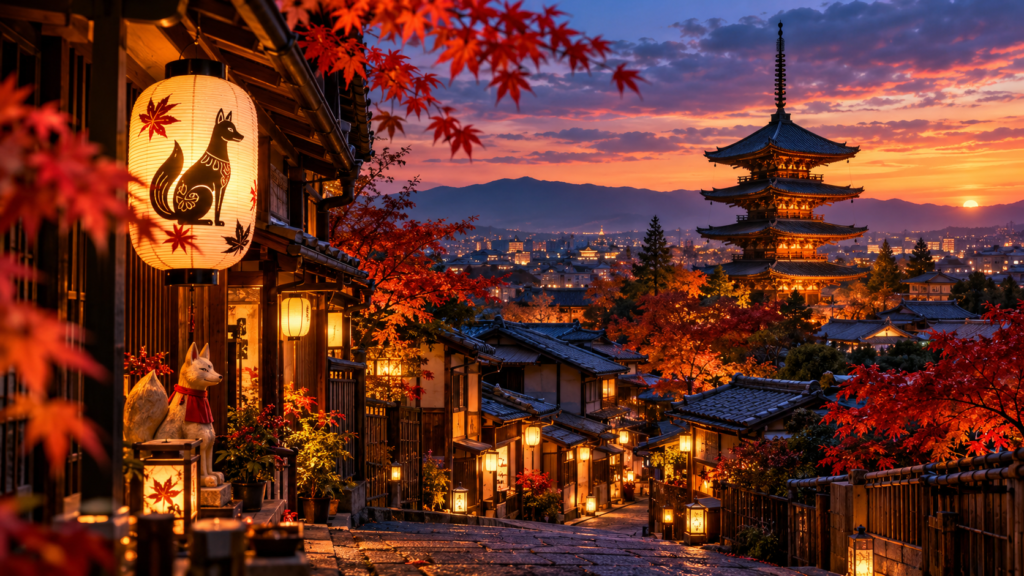
An atmospheric autumn journey through Kyoto’s supernatural folklore, mysterious temples, legendary creatures, lantern-lit streets, and seasonal traditions.
Where Autumn Meets the Extraordinary
There is something about Kyoto in autumn that invites the imagination to wander.
Perhaps it is the sound of footsteps along narrow stone streets. Perhaps it is the glow of lanterns beneath wooden eaves, or the way a red maple leaf drifts across the entrance to a centuries-old shrine.
As October settles over Japan’s ancient capital, the city begins its gradual transformation into a landscape of gold, crimson, and amber.
And somewhere between the temples, teahouses, and quiet neighbourhoods, another Kyoto waits to be discovered.
A Kyoto of fox spirits and mysterious creatures. Of ghost stories whispered across generations. Of sacred mountains, forgotten legends, and supernatural beings who have never entirely disappeared from the Japanese imagination.
Halloween may be a relatively modern celebration in Japan, but Kyoto has been telling stories about the mysterious and unexplained for more than a thousand years.
For curious travellers, that makes October a wonderful time to explore.
Not because Kyoto transforms into a haunted theme park, but because its history offers something richer: an invitation to discover the stories that have shaped Japanese imagination across centuries.
Welcome to Halloween in Kyoto, where the extraordinary is never very far from the everyday.
Kyoto in Autumn: A Season of Beautiful Transitions
Autumn arrives in Kyoto gradually.
The air becomes cooler. Seasonal sweets appear in shop windows. Gardens begin changing colour, and the mountains surrounding the city prepare for their spectacular annual display.
The Japanese tradition of kōyō, appreciating autumn foliage, is one of the country’s most beloved seasonal experiences.
In Kyoto, it is almost an art form.
Temples such as Eikan-dō, Tōfuku-ji, and Kiyomizu-dera are celebrated for their autumn scenery, while quieter gardens and neighbourhood paths offer opportunities to enjoy the changing season at a gentler pace.
October generally marks the beginning of the transition, with Kyoto’s most dramatic maple colours usually arriving later in November.
But October has its own pleasures.
There are fewer expectations of perfect foliage, leaving more room to notice the small things: a single red leaf against a moss-covered stone, a warm cup of matcha, or the sound of a temple bell travelling through the evening air.
For travellers drawn to atmosphere rather than spectacle, this can be a particularly rewarding time to visit.
And autumn’s changing landscape provides a fitting setting for exploring Kyoto’s mysterious side.
The World of Yōkai: Japan’s Supernatural Imagination
Long before Halloween costumes appeared in Japanese shopping districts, the country’s folklore was already populated by an extraordinary collection of supernatural beings.
They are known collectively as yōkai.
Some are frightening. Others are playful, troublesome, protective, or simply strange.
Unlike the familiar ghosts and monsters of Western Halloween, yōkai occupy a wonderfully complicated place in Japanese culture.
They may inhabit rivers, mountains, forests, abandoned buildings, household objects, or the spaces between the ordinary and extraordinary.
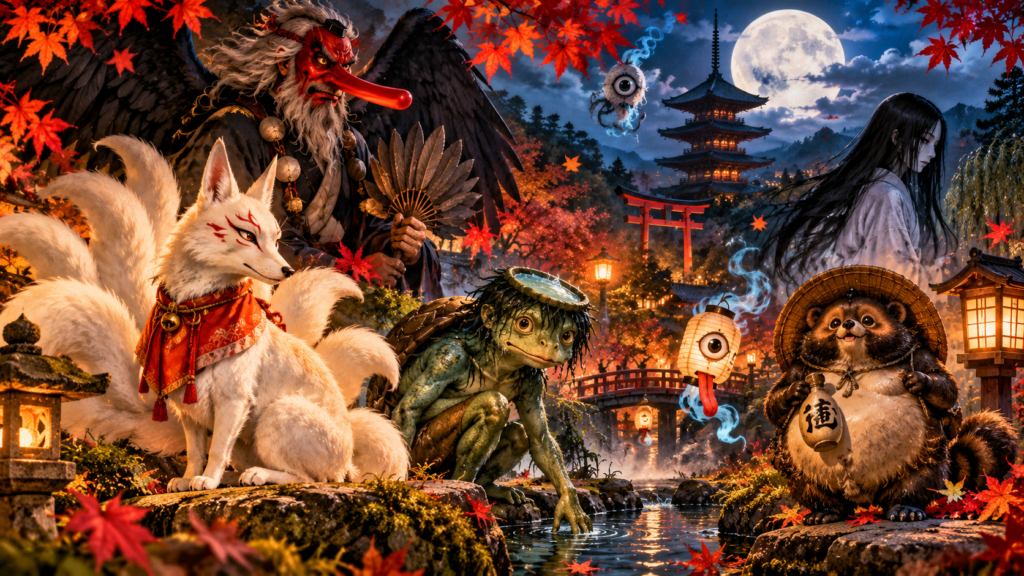
Among the best-known are:
Kitsune: Foxes associated with supernatural abilities, transformation, and, in some traditions, the deity Inari.
Tengu: Mysterious mountain beings frequently depicted with long noses or birdlike characteristics.
Kappa: Water-dwelling creatures associated with rivers and ponds, sometimes dangerous and sometimes comical.
Tanuki: Raccoon dogs famous in folklore for their shapeshifting abilities and playful trickery.
Tsukumogami: Everyday objects said in certain traditions to acquire spirits after many years of existence.
Yōkai stories have evolved through oral storytelling, literature, painting, theatre, manga, and animation.
Their continued popularity reminds us that folklore is not something permanently sealed inside history books.
It changes as people change.
And in Kyoto, one neighbourhood has given these extraordinary creatures a particularly memorable home.
Yōkai Street: Where Folklore Lives in the Neighbourhood
In northwest Kyoto, an ordinary-looking shopping street has developed an extraordinary identity.
Ichijō-dōri, particularly the Taishōgun shopping district, is affectionately known as Yōkai Street.
Its supernatural reputation draws inspiration from the legend of the Hyakki Yagyō, the Night Parade of One Hundred Demons.
According to versions of this old Japanese tradition, supernatural creatures travel together through the night, creating a procession that no ordinary person would wish to encounter unexpectedly.
Today, the shopping street embraces this folklore with handmade monster figures, imaginative displays, and community celebrations.
Visitors may discover peculiar creatures outside shops, charming decorations, and references to legendary beings woven into everyday surroundings.
At certain times, the neighbourhood also hosts yōkai-themed events, although schedules vary and should be checked before travelling.
What makes Yōkai Street special is not simply its supernatural theme.
It is the relationship between imagination and community.
Local businesses have transformed an ancient story into something playful and welcoming, inviting visitors to discover a neighbourhood that might otherwise escape the usual tourist itinerary.
Here, the monsters are part of the neighbourhood.
And they seem quite happy to stay.
Ghost Stories and the Places Between Worlds
Kyoto’s supernatural heritage is not limited to mischievous monsters.
The city has long been associated with stories about spirits, the afterlife, and the boundaries separating the living from the dead.
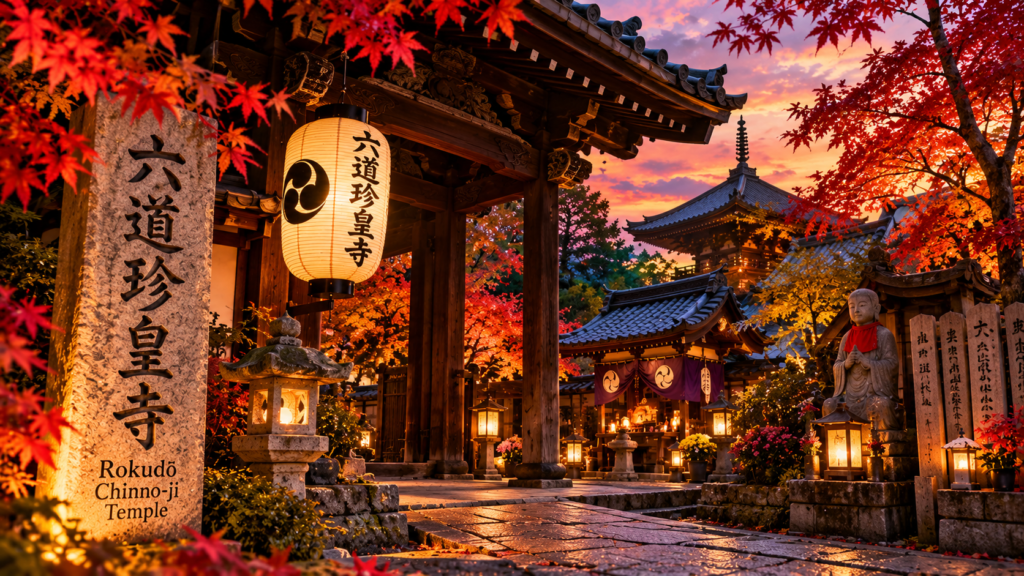
One of its most intriguing locations is Rokudō Chinno-ji Temple.
Located in the Higashiyama area, the temple is associated with Rokudō no Tsuji, a legendary crossroads between this world and the next.
In Japanese Buddhist traditions, the six realms of existence represent different states of rebirth. Over time, the neighbourhood became connected with stories about the passage of souls.
The temple is also associated with Ono no Takamura, a ninth-century court official who, according to legend, travelled between the human world and the underworld.
Imagine that for a moment.
A government official by day.
A traveller to the realm of the dead by night.
Kyoto’s folklore has never lacked imagination.
The temple’s traditions are particularly associated with Obon, the Japanese season of ancestral remembrance, which occurs in summer rather than at Halloween.
That distinction matters.
Japan’s traditions of remembering the dead have their own histories, meanings, and spiritual foundations. They should not be mistaken for Japanese versions of Western Halloween.
Yet for visitors interested in the supernatural, they reveal something fascinating about the ways different cultures understand memory, mortality, and the unseen.
Seimei Shrine: The Mysterious World of the Onmyōji
Another destination for the curious traveller is Seimei Shrine.
Dedicated to Abe no Seimei, the celebrated Heian-period practitioner of onmyōdō, the shrine connects visitors with a fascinating chapter of Japanese history.
Onmyōdō combined elements of cosmology, divination, calendrical knowledge, and ritual practices.
Abe no Seimei became such a legendary figure that his historical achievements eventually intertwined with stories of extraordinary supernatural abilities.
In later folklore and popular culture, he appears as a master of mysterious forces, capable of confronting spirits and protecting people from supernatural danger.
Today, Seimei Shrine is associated with protection and spiritual well-being.
Its distinctive five-pointed star symbol, known as the Seiman, is one of its most recognizable features.
For travellers fascinated by the relationship between history and legend, the shrine offers a glimpse into a world where ancient beliefs continue to inspire contemporary storytelling.
And perhaps that is one of Kyoto’s greatest gifts.
It allows the past to remain part of the present without requiring every mystery to be solved.
Kurama: Sacred Mountains and a Night of Fire
North of central Kyoto, the mountain village of Kurama offers an entirely different autumn atmosphere.
Surrounded by forests and steep hillsides, Kurama has long been associated with spiritual traditions, mountain legends, and stories of tengu.
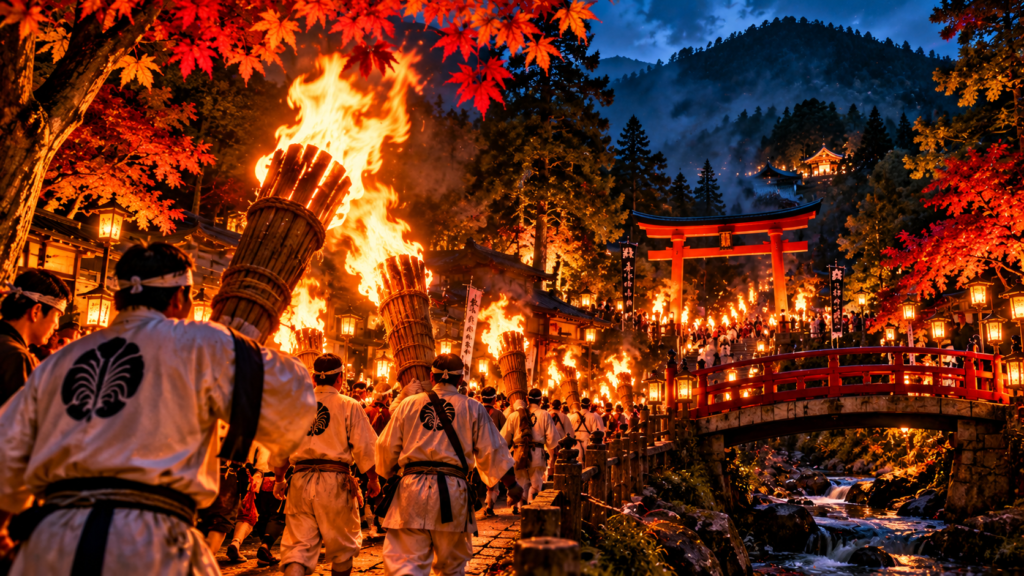
Its most spectacular autumn event is the Kurama Fire Festival, traditionally held annually on October 22.
In 2026, October 22 falls on a Thursday.
The celebration takes place around Yuki Shrine and features large flaming torches carried through the village, creating a remarkable procession of fire and light.
It is a religious and community festival, not a Halloween celebration, and its origins are rooted in local shrine traditions.
Yet the visual atmosphere is unforgettable.
Firelight dances against dark mountain slopes.
Voices echo through narrow streets.
The night becomes a moving landscape of flame, tradition, and collective memory.
Visitors considering the festival should expect significant crowds, transport restrictions, and a late evening. Checking official arrangements before travelling is essential.
For those unable to attend, Kurama remains an intriguing destination at other times of year, with forested mountain scenery and a rich heritage of legend.
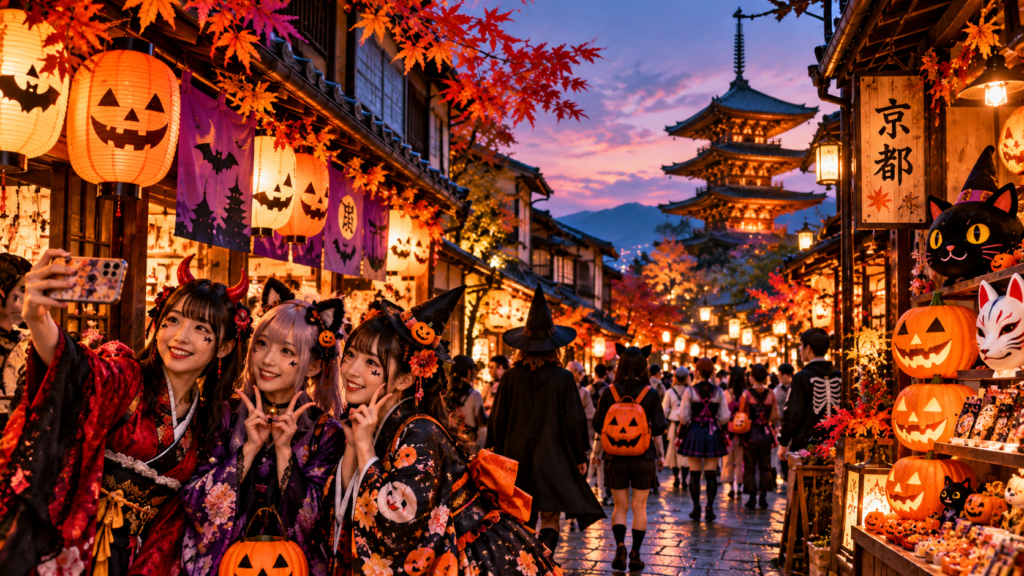
Modern Halloween: Costumes, Creativity and Contemporary Japan
Modern Halloween has found a place in Japan through popular culture, commercial celebrations, costumes, themed attractions, and seasonal entertainment.
In Kyoto, visitors may encounter pumpkin decorations, Halloween sweets, themed café offerings, and occasional costume events.
However, Kyoto is not primarily a large-scale Halloween party destination.
Its appeal lies in the contrast between contemporary celebrations and the city’s extraordinary historical setting.
A shop window filled with cheerful pumpkins may stand only a short walk from a centuries-old temple.
A costume display may appear beside traditional confectionery.
Modern Japan and historic Kyoto share the same streets, creating a fascinating cultural conversation.
Visitors looking for organized Halloween activities should check current listings from local venues, shopping centres, and attractions. Events and admission arrangements can change from year to year.
For travellers who prefer something quieter, Kyoto offers another possibility.
Enjoy Halloween as an invitation to explore stories.
Read a Japanese ghost tale.
Discover a yōkai illustration.
Visit a neighbourhood associated with local legends.
And allow the city to introduce its mysteries in its own way.
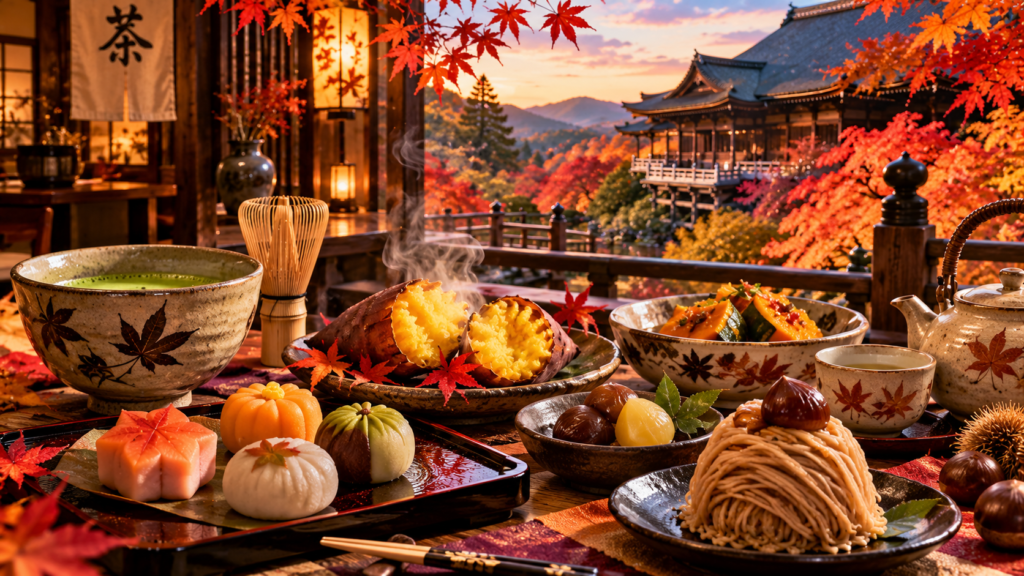
Autumn Flavours: A Taste of Kyoto in October
Autumn in Japan is also a season of delicious discoveries.
Known for its celebration of seasonal ingredients, Japanese cuisine gives October its own distinctive flavours.
Kyoto’s cafés, confectioners, and food shops offer opportunities to enjoy these traditions in settings ranging from contemporary coffee houses to centuries-old establishments.
Some seasonal favourites include:
Kuri (chestnuts): Featured in sweets, rice dishes, cakes, and delicate confections.
Satsumaimo (sweet potatoes): Enjoyed roasted, baked, or transformed into comforting desserts.
Kabocha (Japanese pumpkin): Used in savoury dishes, sweets, and seasonal café creations.
Autumn wagashi: Traditional Japanese confections inspired by maple leaves, chrysanthemums, and other seasonal imagery.
Matcha: Kyoto’s celebrated green tea, especially inviting when paired with a beautifully crafted sweet.
There is something wonderfully comforting about sitting inside a quiet Kyoto teahouse on a cool October afternoon.
Outside, the city continues its busy rhythm.
Inside, there is tea, a small sweet, and permission to linger.
Sometimes the most memorable part of travel is not the destination itself.
It is the moment when you stop moving long enough to feel where you are.
A Gentle Autumn Journey Through Kyoto
For travellers who would like to explore Kyoto’s mysterious side, a little planning can bring several of its stories together.
Morning: Seimei Shrine and Yōkai Street
Begin your exploration at Seimei Shrine, where the legend of Abe no Seimei introduces Kyoto’s mysterious history.
From there, continue toward Yōkai Street in the Taishōgun shopping district.
Spend time discovering its unusual decorations, neighbourhood businesses, and playful connections to Japanese folklore.
Afternoon: The Stories of Higashiyama
Travel across the city toward Rokudō Chinno-ji Temple.
Here, the legends surrounding the boundary between the living and the dead offer a thoughtful introduction to Kyoto’s spiritual heritage.
Continue toward Kiyomizu-dera, allowing time to enjoy the historic streets, small shops, and changing autumn scenery.
Evening: Lanterns and Quiet Discoveries
As evening approaches, wander toward Yasaka Shrine and Gion.
Enjoy the traditional streets, atmospheric lighting, and opportunities to discover a quiet teahouse or seasonal sweet.
This is a thematic route rather than a short continuous walk. Public transport or taxis are useful between the western and eastern portions of the city, and temple visiting hours should be checked.
There is no need to hurry.
Kyoto rewards the traveller who leaves space for unexpected discoveries.
A quiet garden.
A tiny shop.
An unfamiliar sweet.
A story waiting just around the corner.
A Kyoto Halloween Evening
Imagine the final hours of an October day.
The sky above Kyoto has softened into shades of lavender and blue.
The last visitors are leaving a temple courtyard. A shopkeeper adjusts a lantern. Somewhere nearby, a bicycle passes along a narrow street.
The city is not silent.
But it has begun to settle.
You pause outside a small shop where a curious little yōkai figure watches over the entrance.
Is it frightening?
Not particularly.
It seems more interested in the passing world than in causing anyone trouble.
You smile and continue walking.
A few streets later, the warm light of a teahouse catches your attention.
There is still time for something sweet.
Still time to watch the evening unfold.
Still time to wonder how many stories have travelled through these streets before you arrived.
In Kyoto, the supernatural does not always announce itself with a scream.
Sometimes it arrives as a question.
What do we remember?
What do we imagine?
And how much of the world remains mysterious simply because we have forgotten how to look?
Poppy’s Closing Reflection: The Stories That Stay With Us
There are many ways to celebrate Halloween.
Some people love costumes and parties. Others prefer ghost stories, candlelight, autumn walks, or the quiet pleasure of watching the seasons change.
Kyoto offers something a little different.
It reminds us that stories about the unseen are not confined to one holiday, one country, or one tradition.
They are part of humanity’s ongoing effort to understand the world.
The Japanese yōkai, the legends of ancient Kyoto, and the city’s enduring spiritual traditions belong to their own cultural histories.
They deserve to be approached with curiosity and respect.
But they also invite a universal kind of wonder.
The wonder of discovering that people across centuries and continents have looked into dark forests, unfamiliar landscapes, and star-filled skies and imagined extraordinary possibilities.
Perhaps that is why these stories endure.
Not because we need to believe every legend.
But because imagination helps us see beyond what is immediately visible.
And sometimes, when the world feels too loud or hurried, that is exactly the kind of journey we need.
So wherever this Halloween finds you, perhaps you might borrow a little of Kyoto’s autumn spirit.
Make yourself something warm.
Listen to a story.
Notice the changing light outside your window.
And remember that curiosity can turn even an ordinary evening into a small adventure.
From Kyoto, with lantern light and autumn wishes,
Poppy Sawayama
Asia Travel Writer | Go Cybernaut
A Note From Go Cybernaut
Go Cybernaut celebrates cultural discovery through curiosity, kindness, and respect.
Japan’s yōkai traditions, Buddhist beliefs, Shinto practices, and seasonal festivals are distinct from Western Halloween customs. This feature explores their connections through storytelling and atmosphere without suggesting that they share identical meanings or origins.
We encourage travellers to respect sacred spaces, follow local photography and visitor guidelines, support neighbourhood businesses, and check official event information before visiting.
Because the best journeys are not simply about discovering new places.
They are also about learning how to be thoughtful guests.
Go Cybernaut’s Cybernauts are AI-assisted editorial personalities, developed with human creative direction and stewardship.
Plan Your Kyoto Autumn Adventure
For current visitor information, festival schedules, and seasonal updates, explore these resources:
Travel information is provided for inspiration and planning. Festival dates, admission requirements, transport arrangements, and opening hours should be confirmed through official sources before visiting.
Discover more with Go Cybernaut
At Go Cybernaut, every destination is an invitation to explore the world with curiosity, imagination, and kindness.
Whether you travel across continents or discover something wonderful from the comfort of home, there is always another story waiting.
Keep exploring. Stay curious. And wherever your journey takes you, may you always find a soft place to land.
🌟 Support the Go Cybernaut Constellation
Go Cybernaut is a soft place for curiosity, music, discovery, and storytelling. Every article, playlist, and celebration is created to help people feel a little less alone and a little more inspired.
If something here brightened your day, you can help keep the constellation shining:
☕ Buy Me a Coffee
📚 Visit the Cybernaut Bookstore
🎶 Explore our curated playlists
✉️ Join the weekly newsletter
🛍️ Visit & Shop on Market Street
Every visit, share, and small contribution helps this creative space continue to grow.
Thank you for being part of the journey. 🌿
Go Cybernaut is a human-led cultural discovery and celebration publisher, created by Gayle Olson with an AI-supported editorial constellation. Through accessible guides, playlists, stories, and seasonal celebrations, it creates a soft place to land for curious people seeking connection, delight, and discovery.
Go Cybernaut is an infotainment network created by one human and a constellation of AI personalities to bring a variety of resources and media to you!
Any relationship or resemblance to humans or imagined characters, past or present, is purely coincidental.
A Note About Comments
Because of the high amount of spam comments on the blog, we have closed the comment option for now.
We still warmly welcome your voice, thoughts, and friendly conversation. Please feel free to join us and post on our Facebook Page:
