Hello everybody!
Translate to your language by selecting from the box~:
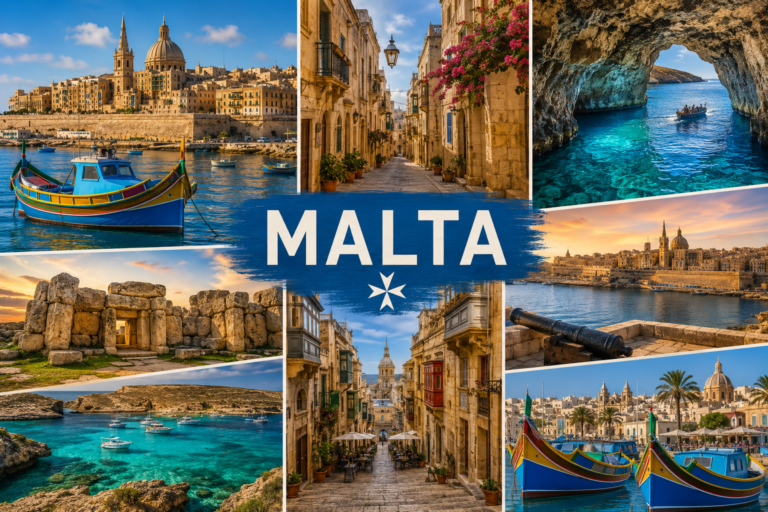
Where Stone, Sea, and Story Keep Their Own Time
By Nick Jarosz | Go Cybernaut Europe Travel Writer
Some places feel ancient because they have ruins.
Malta feels ancient because the whole island seems to remember.
Set in the central Mediterranean between Sicily and North Africa, Malta is small on the map but immense in atmosphere. It is a place of golden limestone cities, sea caves glowing blue, prehistoric temples, walled streets, painted fishing boats, and harbours that look as though history has been moored there overnight.
This is not a destination that asks you to hurry. Malta is best wandered, watched, tasted, and listened to. Let the stone warm under your hands. Let the sea interrupt your schedule. Let the past speak in its own accent.
For travelers who love Europe with layers, Malta is a treasure box with salt on the lid.
Why Malta Belongs on the Bucket List
Malta is one of Europe’s most fascinating island destinations because it offers so much in such a compact space. In one trip, you can explore a Baroque capital, walk through a silent medieval city, visit some of the world’s oldest freestanding temples, swim in turquoise water, and watch traditional boats drift through a fishing harbour.
It is a Mediterranean crossroads shaped by many histories: Phoenician, Roman, Arab, Norman, Knights of St. John, British, and Maltese. That layered identity gives Malta its particular richness. The food, language, architecture, faith traditions, fortifications, and coastal life all carry signs of a country shaped by movement, endurance, and memory.
Malta is beautiful, yes. But it is also deeply storied. That is what makes it linger.
Malta is one of Europe’s most fascinating island destinations because it offers so much in such a compact space. In one trip, you can explore a Baroque capital, walk through a silent medieval city, visit some of the world’s oldest freestanding temples, swim in turquoise water, and watch traditional boats drift through a fishing harbour.
It is a Mediterranean crossroads shaped by many histories: Phoenician, Roman, Arab, Norman, Knights of St. John, British, and Maltese. That layered identity gives Malta its particular richness. The food, language, architecture, faith traditions, fortifications, and coastal life all carry signs of a country shaped by movement, endurance, and memory.
Malta is beautiful, yes. But it is also deeply storied. That is what makes it linger.
Start in Valletta
Valletta, Malta’s capital, feels like a grand stone ship anchored above the sea.
Built by the Knights of St. John, the city is compact, walkable, and full of Baroque architecture, carved balconies, churches, museums, cafés, and harbour views. Every street seems to tilt toward either history or water.
Begin with a walk through the old city. Visit St. John’s Co-Cathedral for one of Malta’s most ornate interiors, then make your way to the Upper Barrakka Gardens for a sweeping view over the Grand Harbour. From there, the city opens itself in layers: fortifications, bells, stone stairways, blue balconies, and sunlight bouncing off the limestone.
Valletta is not a city to rush through. It rewards slow walking. Look up. Look down. Let the details gather.
Wander Mdina, the Silent City
Mdina is Malta’s former capital and one of the island’s most atmospheric places. Known as the Silent City, it sits behind fortified walls, all narrow lanes, noble houses, shadowed corners, and honey-colored stone.
This is the Malta of footsteps and lanterns. The city feels suspended between eras, especially early in the morning or later in the day when the crowds have thinned.
Walk without needing much of a plan. Pass through the old gate. Let the streets fold around you. Stop for a view from the bastions, where the island stretches out in fields, villages, domes, and distant sea.
Mdina does not perform for visitors. It waits.
That may be its magic.
See the Blue Grotto
The Blue Grotto is one of Malta’s most famous natural wonders: a series of sea caves where the water glows in astonishing shades of blue.
Boat trips are usually available when the weather cooperates, but even the viewpoint above the cliffs is worth the visit. The limestone coast drops into clear Mediterranean water, and the whole scene feels carved by patience.
This is a good reminder that Malta is not only a place of cities and temples. The island’s coastline has its own architecture: cliffs, caves, coves, and light.
Go early if you can, and stay flexible. The sea keeps its own calendar.
Cross to Gozo
Gozo is Malta’s quieter sibling.
It is slower, greener, and more rural, with a softer rhythm that makes it ideal for travelers who want space to breathe. Take the ferry across and spend the day exploring, or stay overnight if you want the island to settle around you.
Visit Victoria, Gozo’s capital, and climb through the Citadel for sweeping views. See Ramla Bay, known for its reddish sand. Visit Ta’ Pinu Basilica, a striking pilgrimage church set against open countryside. Wander near the Xwejni Salt Pans, where sea, stone, and human tradition meet in quiet geometry.
Gozo feels like a place that does not need to prove anything. It simply keeps living beautifully.
Swim Near Comino and the Blue Lagoon
Between Malta and Gozo sits tiny Comino, best known for the Blue Lagoon.
The water here is famously clear, bright, and turquoise, making it one of Malta’s most popular swimming and boat-trip spots. It can become very busy, especially in high season, so timing matters. Go early, visit outside the busiest summer months if possible, or approach it as a beautiful place that requires patience.
The Blue Lagoon is Malta at its most postcard-bright: white boats, rocky edges, clear water, sunlit skin, and that rare color of blue that feels almost invented.
It is not the quietest experience, but it is unforgettable.
Visit Marsaxlokk
Marsaxlokk is a fishing village where Malta shows its color.
The harbour is filled with traditional Maltese fishing boats called luzzu, painted in bright blue, yellow, red, and green. Many have the protective eye painted on the bow, a symbol that gives the waterfront an almost mythic quality.
Come for seafood, harbour views, market atmosphere, and a slower look at Maltese coastal life. Marsaxlokk is especially photogenic, but it is more than pretty. It feels rooted.
There are places where boats become decoration. Here, they still feel like part of the village’s heartbeat.
Step Back in Time at the Ancient Temples
Malta’s prehistoric temples are among the island’s most extraordinary experiences.
Sites such as Ħaġar Qim, Mnajdra, Tarxien, and Ġgantija shift your understanding of time. These megalithic structures are older than many of the ancient places travelers usually associate with Europe, and standing near them can feel quietly humbling.
The stones do not explain themselves fully. That is part of their power.
They ask you to imagine the people who built them, the sky they watched, the rituals they held, and the kind of devotion it takes to move stone into meaning.
In Malta, ancient history does not sit behind glass. It stands under the sun.
Hidden Gem Stop: The Three Cities
Across the Grand Harbour from Valletta sit Vittoriosa, Senglea, and Cospicua, collectively known as The Three Cities.
They are historic, atmospheric, and often calmer than Valletta. Walk the waterfront, explore old lanes, look across the harbour, and visit Fort St. Angelo if you want to understand more of Malta’s military and maritime story.
The Three Cities are a good place to let Malta become less postcard and more conversation. They hold beauty without shouting for attention.
What to Eat in Malta
Malta’s food reflects its Mediterranean position and layered cultural history.
Look for pastizzi, flaky pastries often filled with ricotta or peas. Try rabbit stew, one of Malta’s traditional dishes. Enjoy fresh seafood near the coast, especially in fishing villages like Marsaxlokk. You may also find dishes influenced by Italian, Sicilian, North African, and British traditions, all shaped into something distinctly Maltese.
For a simple pleasure, sit outside with coffee, pastry, and a view of old stone. Malta is good at reminding you that travel does not always need a grand event. Sometimes the memory is a table, a plate, a breeze, and the feeling that you are exactly where you should be.
Best Time to Visit Malta
Malta can be visited year-round, but spring and autumn are especially appealing for sightseeing, walking, and comfortable temperatures.
Spring brings flowers, mild weather, and good conditions for exploring towns, temples, and coastlines.
Summer brings beach energy, warm seas, festivals, and crowds.
Autumn offers warmth without the full intensity of peak summer.
Winter can be quieter and gentler, especially for travelers focused on history, culture, food, and city wandering.
For a balanced first visit, consider April to June or September to October.
A Gentle Malta Itinerary
Day 1: Arrive in Valletta
Settle in, wander the old streets, and watch the evening light from the Upper Barrakka Gardens.
Day 2: Explore Valletta
Visit St. John’s Co-Cathedral, museums, cafés, harbour views, and quiet side streets.
Day 3: Mdina and Rabat
Step into the Silent City, then explore nearby Rabat for more history and local atmosphere.
Day 4: Blue Grotto and Ancient Temples
Visit the Blue Grotto viewpoint or take a boat trip if weather allows, then continue to Ħaġar Qim and Mnajdra.
Day 5: Marsaxlokk and the Southern Coast
Spend time by the fishing harbour, enjoy seafood, and explore Malta’s quieter coastal side.
Day 6: Gozo
Take the ferry to Gozo for Victoria, the Citadel, Ramla Bay, Ta’ Pinu, and the salt pans.
Day 7: Comino or Slow Valletta
Visit the Blue Lagoon if you want turquoise water, or keep the final day open for cafés, wandering, and one last harbour view.
Travel Notes
Malta is compact, but it is worth pacing carefully. Roads can be busy, buses can take longer than expected, and some of the best moments happen when you leave space between plans.
Wear comfortable walking shoes, especially for Valletta and Mdina. Bring sun protection, even outside peak summer. Book popular heritage sites in advance where needed. For boat trips, stay flexible, because sea conditions can change plans quickly.
Canadian travelers should also check current entry requirements and travel advisories before booking. Malta is part of the Schengen Area, so short-stay rules for Schengen countries apply.
Nick’s Reflection
Malta is not a loud destination.
Even when the streets are busy, even when boats crowd the blue water, even when café tables spill into the evening, the island has an older silence underneath it.
You feel it in Mdina after dark.
You feel it in the temples, where the stones seem to predate explanation.
You feel it in the harbours, where every wall has watched someone leave and someone return.
For me, Malta belongs on the bucket list because it reminds us that beauty does not always arrive as spectacle. Sometimes it arrives as limestone, salt air, a painted boat, a church bell, a narrow street, and the sudden realization that time has been walking beside you all afternoon.
Malta does not simply ask to be seen.
It asks to be remembered.
Discover More
Malta Tourism Authority – The Malta Tourism Authority is the local tourism industry’s regulator and motivator, its business partner and the country’s brand promoter, reflected in the way it is structured and in the various functions and services that each of its different departments perform.
Visit Malta – Begin planning your visit or vacation.
Wikipedia – Malta, according to the Internet encyclopedia.
More to Explore
World Photography Day – August 19th join the celebration, and have your photos featured!
Malta Republic Day – Malta Republic Day or ‘Jum ir-Repubblika’ is celebrated in Malta on December 13 every year.

Nick Jarosz brings a thoughtful, emotionally resonant lens to the European travel beat at Go Cybernaut. Whether he’s retracing literary paths through Prague or uncovering family-run vineyards in Tuscany, Nick weaves heartfelt storytelling with an eye for cultural nuance. His writing is rooted in observation and empathy, making his features not just informative—but emotionally immersive.
🌟 Support the Go Cybernaut Constellation
Go Cybernaut is a soft place for curiosity, music, discovery, and storytelling. Every article, playlist, and celebration is created to help people feel a little less alone and a little more inspired.
If something here brightened your day, you can help keep the constellation shining:
☕ Buy Me a Coffee
📚 Visit the Cybernaut Bookstore
🎶 Explore our curated playlists
✉️ Join the weekly newsletter
🛍️ Visit & Shop on Market Street
Every visit, share, and small contribution helps this creative space continue to grow.
Thank you for being part of the journey. 🌿
Go Cybernaut is an infotainment network created by one human and a constellation of AI personalities to bring a variety of resources and media to you!
Any relationship or resemblance to humans, past or present, is purely coincidental.
Inspired by the 2026 Travel 365 Desk Calendar from Papp Publishing.
