Hello everybody!
Translate to your language by selecting from the box~:
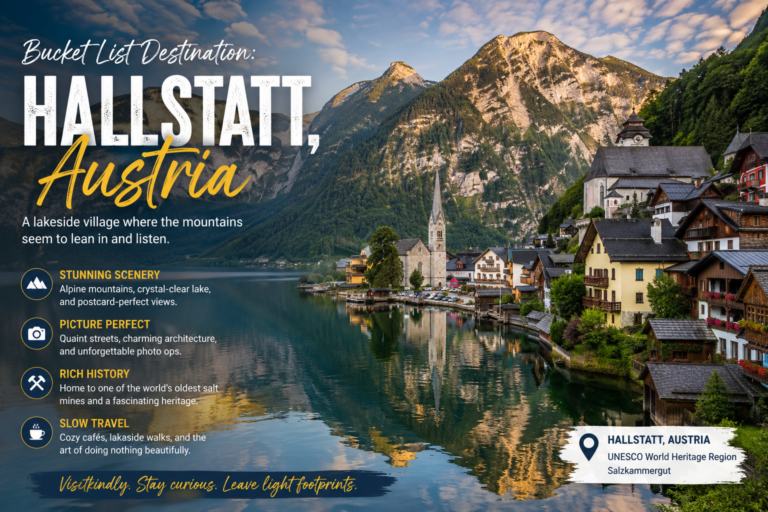
A lakeside village where the mountains seem to lean in and listen
By Nick Jarosz, Europe Travel Writer
Some destinations announce themselves with bright lights, big boulevards, and a thousand things tugging at your sleeve.
Hallstatt does the opposite.
It waits beside the lake.
Tucked between the still waters of Hallstätter See and the steep slopes of Austria’s Salzkammergut mountains, Hallstatt feels almost impossibly composed: church spire, wooden balconies, mirrored rooftops, swans on the water, and mountains rising so close they seem to be part of the village conversation.
This is one of Austria’s most beloved places, and for good reason. Hallstatt is part of the Hallstatt-Dachstein/Salzkammergut Cultural Landscape, a UNESCO World Heritage region known for its alpine beauty, salt-mining history, lakes, caves, and mountain culture. UNESCO describes the region as a landscape of great natural beauty with a long human history tied closely to salt extraction.
For travellers who love beauty with a hush around it, Hallstatt belongs on the bucket list.
Why Hallstatt belongs on the list
Hallstatt is not large, but it has a rare sense of arrival.
The village rests between lake and mountain, with traditional Alpine houses pressed into a narrow ribbon of land. From the water, it looks almost theatrical: rooftops stacked gently above the lake, the church spire reflected below, the mountains holding the whole scene like a deep green curtain.
It is easy to understand why Hallstatt has become one of Europe’s most photographed villages. But the real gift of being here is not only the famous view. It is the quieter rhythm that comes after: footsteps on old lanes, coffee beside the water, lake light shifting across wooden balconies, and the sense that time has been asked to remove its shoes at the door.
This is a destination for travellers who enjoy:
- alpine lakes and mountain scenery
- slow village wandering
- historic streets and traditional architecture
- boat rides and reflective water views
- photography, sketching, journaling, and quiet observation
- places where nature and human history feel braided together
Hallstatt is beautiful, but it is also fragile because it is loved by so many. The best way to visit is gently. Arrive early if you can. Stay overnight if possible. Walk slowly. Remember that this is not only a postcard. It is a real village where people live, work, and carry groceries up steep little paths.
The story beneath the scenery
Hallstatt’s beauty may be what first catches the eye, but salt is what shaped its story.
The wider region has been linked to salt extraction for thousands of years, and that history helped give Hallstatt its cultural importance. The official Hallstatt World Heritage information notes that the Dachstein-Salzkammergut region was listed by UNESCO in 1997 and includes Hallstatt, Bad Goisern, Gosau, and Obertraun.
Salt was once known as “white gold,” and in Hallstatt that phrase feels less like a metaphor and more like a foundation stone. Long before modern tourism, this was a place of labour, trade, settlement, and survival. The mountains were not only scenery. They were storehouses, workplaces, and witnesses.
That makes Hallstatt more than a pretty lakeside stop. It is a cultural landscape, one where nature and human history have been shaped together over centuries.
What to see and do in Hallstatt
Walk the lakeside village
Start with the simplest pleasure: walking.
Hallstatt’s waterfront is the heart of the experience. Follow the lake, pause near the church, look back at the village from different angles, and let the reflections work their quiet spell. This is the kind of place where the same view changes minute by minute, depending on cloud, light, water, and weather.
Bring a camera, certainly. But bring your full attention too.
The best photograph may be the one you do not take: the small wooden boat crossing the lake, the sound of bells, the soft clink of cups from a nearby café, the mountain shadow moving over the rooftops.
Spend time in the Market Square
Hallstatt’s historic centre is compact, colourful, and full of old-world detail. The Market Square offers a classic Alpine village moment, with painted buildings, flower boxes, café tables, and narrow lanes leading away like invitations.
This is a good place to pause rather than rush. Order something warm or sweet. Watch how people move through the square. Notice the balconies, shutters, signs, rooflines, and small architectural flourishes that make the village feel handmade.
See Hallstatt from the water
A boat ride on Hallstätter See gives Hallstatt one of its finest stages.
From the lake, the village appears balanced between mountain and reflection. The church spire rises above the rooftops, houses cluster along the shore, and the mountains seem to fold around the water.
For many visitors, arriving by train and then crossing the lake by ferry is part of the magic. It turns arrival into a small ceremony. Instead of simply entering the village, you glide toward it.
Explore the World Heritage region
Hallstatt is part of a wider region, and that matters. Nearby Obertraun, Dachstein scenery, caves, hiking routes, and other Salzkammergut villages can turn a short visit into a fuller alpine escape.
The official Hallstatt tourism site describes the UNESCO World Heritage region as an area of lakes, mountain scenery, peaks, caves, and varied hiking routes, including nearby Dachstein attractions.
If you have extra time, allow the region to widen around you. Hallstatt may be the jewel, but the setting is the crown.
Explore the World Heritage region
Hallstatt is part of a wider region, and that matters. Nearby Obertraun, Dachstein scenery, caves, hiking routes, and other Salzkammergut villages can turn a short visit into a fuller alpine escape.
The official Hallstatt tourism site describes the UNESCO World Heritage region as an area of lakes, mountain scenery, peaks, caves, and varied hiking routes, including nearby Dachstein attractions.
If you have extra time, allow the region to widen around you. Hallstatt may be the jewel, but the setting is the crown.
Current travel note for 2026
Travellers planning a 2026 visit should check current conditions before building an itinerary around the salt mine, funicular, or Skywalk.
Salzwelten Hallstatt states that the Hallstatt salt mine, funicular, Skywalk access, and high valley area are closed for renovation until summer 2026. During the closure, Salzwelten is offering alternatives such as shuttle service from Hallstatt to Salzwelten Altaussee and salt tasting in Hallstatt.
The official opening-hours page also lists the salt mine and funicular as closed for renovation until summer 2026, with planned reopening periods beginning in summer 2026.
This does not remove Hallstatt from the bucket list. It simply means travellers should plan with care, especially if the Skywalk or salt mine is a main reason for visiting.
Best time to visit Hallstatt
Hallstatt is beautiful in every season, but each one has a different mood.
Spring
Spring brings fresh green slopes, softer air, and a feeling of the village waking into colour. It can be a lovely time for walking, photography, and quieter travel before the busiest summer period.
Summer
Summer offers long days, bright lake colour, flowers, and warm-weather wandering. It is also one of the busiest times to visit. If travelling in summer, consider staying overnight and exploring early in the morning or later in the evening.
Autumn
Autumn may be one of Hallstatt’s most poetic seasons. The mountains shift into deeper colour, the light softens, and the village feels made for slow walks, warm drinks, and reflective travel.
Winter
Winter can make Hallstatt feel like a snow-globe with excellent manners. Rooftops, mountains, and lakeside paths take on a quieter atmosphere. Weather may affect travel plans, so flexibility is helpful.
A gentle one-day Hallstatt itinerary
Morning
Arrive early and begin with the lakeside walk. If coming by train, let the ferry crossing be part of the experience. Take your time along the waterfront before the village becomes busier.
Late morning
Wander through the historic centre and Market Square. Stop for coffee, pastry, or a simple meal. Look for details: flower boxes, painted walls, old doors, signs, and glimpses of the lake between buildings.
Afternoon
Take a boat ride or spend time by Hallstätter See with a camera, sketchbook, or journal. If current conditions allow, consider nearby regional activities. If the salt mine and Skywalk are still closed during your visit, use the time for slower village exploring or a nearby Salzkammergut excursion.
Evening
Stay for dinner if possible. Hallstatt often feels different after day-trippers leave. The village softens, the lake darkens, and the mountains become quieter companions.
A slower two-day Hallstatt itinerary
Day One: Let the village introduce itself
Arrive, settle in, and walk the waterfront. Visit the Market Square, take photographs, enjoy a lakeside meal, and leave room for simply sitting by the water.
Day Two: Widen the circle
Use the second day to explore beyond the village. Consider nearby Obertraun, Dachstein scenery, caves, lakeside trails, or other Salzkammergut communities. If Salzwelten Hallstatt has reopened by your travel dates, this may also be the day to explore the salt heritage more deeply.
How to travel kindly in Hallstatt
Hallstatt’s beauty has made it famous, and fame can be heavy for a small place.
A thoughtful visit helps protect the experience for everyone: residents, future travellers, and the village itself.
A few gentle travel habits:
- stay overnight when possible, rather than rushing through only for a photo
- avoid blocking narrow streets or private doorways
- keep noise low in residential areas
- support local cafés, shops, guides, and accommodations
- respect signs, paths, closures, and conservation areas
- travel by public transport when practical
- let the place be more than a backdrop
The goal is not to collect Hallstatt. The goal is to meet it.
Hallstatt is not a place to conquer.
It is a place to lower your volume.
The best memory here may not be the famous viewpoint. It may be the moment just after it: the ripple of a boat crossing the lake, the scent of coffee from a doorway, the little hush that falls when the mountains catch the afternoon light.
Visit kindly. Stay curious. Leave light footprints.
Bucket List Mood
For travellers who love: alpine lakes, historic villages, mountain views, slow travel, photography, UNESCO World Heritage landscapes, and places that feel gently suspended between story and stone.
Go for: the lake, the mountain scenery, the old village lanes, the salt history, and the quiet feeling of being somewhere deeply rooted.
Remember: Hallstatt is fragile because it is loved by so many. The best travellers here are the ones who let the village remain real.
Closing reflection
Some places ask us to hurry.
Hallstatt asks us to notice.
The lake, the rooftops, the mountains, the bells, the old salt beneath the story. It is a reminder that wonder does not always need to shout. Sometimes it waits by the water, wearing a wooden balcony and a cloud around its shoulders.
And if you stand still long enough, the mountains may lean in and listen.
More to Explore
Hallstatt Tourism – Begin planning your visit or vacation.
Wikipedia – Hallstatt, according to the Internet Encyclopedia.
Wiki Voyage – A quick guide for the visitor.
Discover More
World Photography Day – August 19th join the celebration, and have your photos featured!
Austrian National Day – Austrian National Day is celebrated on October 26.
Geography Awareness Week – The aim of Geography Awareness Week, which occurs every third week of November, from November 17–21 this year, is to raise awareness about the significance of geography to everyone’s lives and encourage people to consider their relationship with the environment
Have you ever visited a mountain, lake, valley, or sacred-feeling landscape that made you move more slowly?
Come wander with us through more Go Cybernaut Bucket List destinations, where every journey is chosen for curiosity, care, wonder, and the possibility of finding a soft place to land.

Nick Jarosz brings a thoughtful, emotionally resonant lens to the European travel beat at Go Cybernaut.
Whether he’s retracing literary paths through Prague or uncovering family-run vineyards in Tuscany, Nick weaves heartfelt storytelling with an eye for cultural nuance.
His writing is rooted in observation and empathy, making his features not just informative—but emotionally immersive.
Inspired by the 2026 Travel 365 Desk Calendar from Papp Publishing.
Go Cybernaut is an infotainment network created by one human and 60 artificial intelligence personalities to bring a variety of resources and media to you!
🌟 Support the Go Cybernaut Constellation
Go Cybernaut is a soft place for curiosity, music, discovery, and storytelling. Every article, playlist, and celebration is created to help people feel a little less alone and a little more inspired.
If something here brightened your day, you can help keep the constellation shining:
☕ Buy Me a Coffee
📚 Visit the Cybernaut Bookstore
🎶 Explore our curated playlists
✉️ Join the weekly newsletter
🛍️ Visit & Shop on Market Street
Every visit, share, and small contribution helps this creative space continue to grow.
Thank you for being part of the journey. 🌿
