Hello everybody! Put on your headphones or turn up the speakers!
Translate to your language by selecting from the box~:
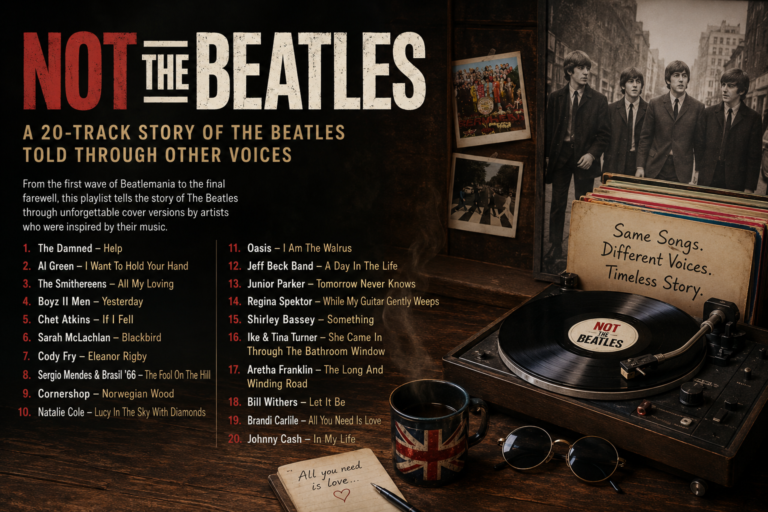
Some songs become so familiar that they stop belonging to one band, one decade, or one recording. They become part of the shared weather. They drift through radios, movies, kitchens, car windows, record shops, late-night headphones, and memory itself.
The Beatles are one of those rare musical constellations whose songs have kept changing shape long after the original recordings were made. Their music has been carried by soul singers, rock bands, folk voices, country storytellers, jazz players, orchestras, punks, pop stars, and quiet interpreters who found something personal inside songs the world already thought it knew.
“Not the Beatles” is a playlist built from Beatles songs performed by other artists. But rather than arranging these covers as a simple tribute, this 20-track journey tells a story of The Beatles themselves.
It begins with the pressure behind the smiles. It moves through Beatlemania, tenderness, loneliness, psychedelia, experimentation, spiritual searching, fracture, farewell, and finally legacy. These are not the original Beatles recordings, yet their story is everywhere inside them.
Same songs. Different voices. Timeless story.
The Damned – Help
The story begins not with triumph, but with a cry.
“Help” may have arrived wrapped in the bright energy of mid-1960s pop, but beneath it was something more complicated: fatigue, pressure, and the dizzying weight of being young, famous, and watched by the entire world. In The Damned’s version, the song’s urgency becomes sharper, rougher, more exposed.
It reminds us that Beatlemania was not only screaming crowds and flashbulbs. It was also confinement. It was being adored and consumed at the same time. This is the opening chapter where the myth starts to crack just enough for the human voice underneath to get through.
AL GREEN – I WANT TO HOLD YOUR HAND
Then comes the spark.
“I Want to Hold Your Hand” was one of the songs that helped send The Beatles from British sensation to global phenomenon. Al Green’s version adds warmth and soul, turning early Beatlemania into something silky and human.
This is the chapter of arrival: the handclaps, the rush, the giddy simplicity of connection. Before the philosophical turns, before the studio experiments, before the long goodbye, The Beatles first offered something direct and electric.
A hand reaching out.
A world reaching back.
THE SMITHEREENS – ALL MY LOVING
The early Beatles were always moving.
Stages, vans, trains, airports, television studios, hotel rooms, and girls waving from platforms. “All My Loving” captures that young, road-worn romance: the promise sent across distance, the tenderness folded into motion.
The Smithereens keep the song’s pulse alive while giving it a slightly tougher guitar-band edge. In this chapter, The Beatles are still charming, still clean-cut in the public imagination, but the machinery around them is already speeding up.
Love becomes something posted from the road.
BOYZ II MEN – YESTERDAY
Then the shadow enters.
“Yesterday” marks one of the first great emotional turns in The Beatles’ catalogue. Suddenly, the band that had helped define youthful exhilaration was offering regret, fragility, and memory.
Boyz II Men bring vocal tenderness and harmony to the song’s ache, allowing it to bloom as a confession. This is the moment where The Beatles become more than a pop group. They become a vessel for private sadness.
The songs are no longer only for dancing.
Now they know how to sit beside grief.
CHET ATKINS – IF I FELL
The Beatles’ early love songs often carried more emotional complexity than their surfaces first suggested. “If I Fell” is delicate, cautious, and full of vulnerability. It is a love song that does not swagger. It asks.
Chet Atkins’ instrumental version turns that hesitation into gentle guitar language. Without lyrics, the melody becomes even more tender, as though the song is thinking before it speaks.
This chapter belongs to doubt, trust, and the small bravery of letting someone matter.
Sarah McLachlan – Blackbird
By the time we reach “Blackbird,” The Beatles’ songs have become places where listeners can bring their own longing.
Sarah McLachlan’s version emphasizes the quiet resilience inside the song. It feels intimate, almost like a hand on the windowsill. “Blackbird” has often been heard as a song of hope, rising, and release, and here it becomes a soft but steady moment in the larger Beatles story.
This chapter is about the people listening from the margins.
The lonely. The waiting. The ones trying to gather enough courage to lift themselves into morning.
CODY FRY – ELEANOR RIGBY
Now the camera pulls back.
“Eleanor Rigby” is one of The Beatles’ great story-songs, a miniature novel in less than three minutes. The band is no longer singing only about romance or youth. They are observing society, loneliness, ritual, and the quiet tragedies people carry unseen.
Cody Fry’s arrangement heightens the drama, giving the song a cinematic sweep. It feels almost architectural, as if the loneliness has walls, windows, and echoing stone.
This is the chapter where The Beatles become storytellers of strangers.
And the strangers feel uncomfortably familiar.
SERGIO MENDES & BRASIL ’66 – THE FOOL ON THE HILL
The world begins to tilt.
“The Fool on the Hill” belongs to the Beatles’ more reflective, colorful period, where innocence and wisdom start swapping masks. Sergio Mendes & Brasil ’66 bring sunlit rhythm and floating sophistication to the song, turning it into something airy and quietly mystical.
This chapter introduces the outsider, the watcher, the person misunderstood by the crowd but still able to see what others miss.
The Beatles’ story now moves beyond fame and romance into perception, imagination, and the private truth of the odd one out.
CORNERSHOP – NORWEGIAN WOOD
“Norwegian Wood” marked a shift in texture and storytelling. The song feels sly, smoky, and literary, with details that suggest more than they explain.
Cornershop’s version connects the song to a broader musical world, reminding us that The Beatles were constantly absorbing, borrowing, listening, and transforming. Folk, Indian classical influence, pop structure, and oblique narrative all begin to mingle.
This chapter is where the room changes.
The furniture is unfamiliar. The air is different. The story does not explain itself completely.
And that becomes part of the spell.
NATALIE COLE – LUCY IN THE SKY WITH DIAMONDS
Now the colors arrive.
“Lucy in the Sky with Diamonds” is one of the great psychedelic doors in The Beatles’ songbook. Language becomes jeweled, strange, and dreamlike. The ordinary world gives way to image, sensation, and fantasy.
Natalie Cole’s interpretation brings elegance and wonder to the song’s surreal landscape. It reminds us that psychedelia was not only distortion and studio trickery. It was also imagination allowed to bloom beyond the rules of realism.
This is the chapter where The Beatles stop describing the world and begin repainting it.
Oasis – I Am the Walrus
With “I Am the Walrus,” nonsense becomes architecture.
Oasis bring swagger and Britpop lineage to one of John Lennon’s most deliberately strange creations. The song is absurd, theatrical, defiant, and full of riddles that refuse to sit politely in a chair.
This chapter belongs to collage, contradiction, and the joy of refusing easy interpretation. The Beatles are no longer trying to be understood in the usual way. Meaning becomes a hall of mirrors.
And somewhere inside the chaos, the band sounds more powerful than ever.
JEFF BECK BAND – A DAY IN THE LIFE
Here we reach the cathedral.
“A Day in the Life” is often treated as one of The Beatles’ towering achievements, a song that turns daily fragments into existential grandeur. News, routine, dream, dread, and orchestral eruption all collide.
The Jeff Beck Band version transforms the song into a wordless storm of feeling. Guitar takes the place of voice, and the melody becomes both elegy and alarm.
This chapter is the summit: The Beatles using the studio not just to record songs, but to build worlds.
Pop music looks up and discovers a ceiling it can break through.
JUNIOR PARKER – TOMORROW NEVER KNOWS
The future arrives early.
“Tomorrow Never Knows” remains one of The Beatles’ most radical recordings, a hypnotic leap into loops, drones, altered consciousness, and surrender. Junior Parker’s version pulls the song into a blues-soul orbit, proving how durable and strange the composition truly is.
This chapter is about release: letting go of old forms, old expectations, old identities.
The Beatles are no longer only a band.
They have become a portal left humming in the wall.
REGINA SPEKTOR – WHILE MY GUITAR GENTLY WEEPS
The inner weather darkens.
“While My Guitar Gently Weeps” carries the sound of sorrow looking around the room and recognizing that something has gone wrong. Regina Spektor’s version, created for Kubo and the Two Strings, brings delicacy and ache to George Harrison’s meditation on love, blindness, and disconnection.
This chapter belongs to fracture. The friendships are strained. The individual voices inside the band are growing stronger, but also pulling apart.
The guitar does not shout.
It mourns.
SHIRLEY BASSEY – SOMETHING
Then George steps forward with a jewel.
“Something” is one of the great love songs in The Beatles’ catalogue, and Shirley Bassey gives it sweeping glamour and emotional grandeur. Her version lifts the song into the spotlight, letting its elegance gleam.
This chapter is important because it reminds us that The Beatles’ story was not only the story of Lennon and McCartney. George Harrison’s creative presence had deepened into something undeniable.
The quiet Beatle was quiet no longer.
He had brought beauty with a steady hand.
Ike & Tina Turner – She Came In Through the Bathroom Window
The late Beatles could still strut.
“She Came In Through the Bathroom Window” belongs to the strange, brilliant patchwork of Abbey Road, where fragments, characters, riffs, jokes, and emotional farewells sit side by side. Ike & Tina Turner give the song muscle and drive, turning it into a burst of swaggering momentum.
This chapter catches the band near the end, still inventive, still playful, still capable of sounding alive in the middle of collapse.
Even when the house is coming apart, the lights are blazing.
ARETHA FRANKLIN – THE LONG AND WINDING ROAD
The farewell begins in earnest.
“The Long and Winding Road” carries the weight of return, regret, and unfinished longing. Aretha Franklin brings gospel depth and human force to the song, making it feel less like a polished goodbye and more like a soul reckoning.
This chapter is the road behind The Beatles: the clubs, the tours, the fame, the studio years, the arguments, the beauty, the business, the brotherhood, the exhaustion.
The road does not end cleanly.
It bends out of sight.
BILL WITHERS – LET IT BE
At the edge of collapse, there is a blessing.
Bill Withers brings warmth and lived wisdom to “Let It Be,” a song that has become a kind of universal comfort. In the Beatles story, it stands near the end as both farewell and release.
This chapter is not about pretending everything is fine. It is about finding stillness when nothing can be fixed by force. It is about allowing the tide to move without trying to command the sea.
The Beatles are breaking apart.
The song opens its hand anyway.
BRANDI CARLILE – ALL YOU NEED IS LOVE
The message survives the breakup.
“All You Need Is Love” began as a global broadcast anthem and became one of the simplest, most enduring statements associated with The Beatles. Brandi Carlile’s version renews the song with sincerity and warmth, letting it feel less like a slogan and more like a promise still under construction.
This chapter belongs to legacy: the idea that love, however complicated, remains the central instruction.
The Beatles did not always live inside that message perfectly.
None of us do.
But the song keeps asking us to try.
JOHNNY CASH – IN MY LIFE
The final chapter looks back.
Johnny Cash’s version of “In My Life” feels like memory carved in wood. His voice brings age, tenderness, and mortality to a song already full of remembrance.
Placed at the end of this playlist, it becomes the perfect closing reflection. The Beatles are now part of personal history: places remembered, people loved, rooms gone quiet, records kept, songs returned to when ordinary words are not enough.
This is where the band becomes more than four people.
They become part of the listener’s own life.
Closing Reflection
“Not the Beatles” is a story told by echoes.
These are not the original recordings, and that is exactly why the playlist matters. A song’s afterlife can reveal its strength. When another artist takes on a Beatles song, something new is uncovered: a bruise, a grin, a prayer, a rebellion, a memory, a doorway.
The Beatles began as four young men from Liverpool. They became a phenomenon, then an experiment, then a mythology, then a shared inheritance. Their songs have outlived the decade that made them famous because they continue to invite reinterpretation.
A punk band can find the panic.
A soul singer can find the ache.
A country voice can find the memory.
A jazz-pop arrangement can find the sunshine.
A guitar can sing what words leave behind.
Together, these 20 covers do not replace The Beatles. They trace the outline of what The Beatles became: not just a band, but a language other musicians still use to speak about longing, wonder, loneliness, love, confusion, beauty, and goodbye.
This is not The Beatles.
And still, somehow, it is The Beatles everywhere.
Explore More Music at Go Cybernaut
If this playlist opened a memory-door, follow the music further. Go Cybernaut gathers playlists, stories, celebrations, sonic offerings, and cultural journeys for curious listeners who still believe a song can change the room.
Come back when you need a new soundtrack, a soft landing place, or a familiar melody heard in an unexpected voice.
More to Explore
National Guitar Day – Celebrate your favorite musical instrument and guitar musicians on February 11.
International Drum Month – International Drum Month is celebrated in May.
Global Beatles Day – Music lovers worldwide come together to celebrate Global Beatles Day on June 25.
National Day of Rock ‘N’ Roll – National Day of Rock ‘n’ Roll is an unofficial national day celebrated on July 7 by Americans. It’s a day to champion the pioneers that helped change the norms and redirect the history of music.
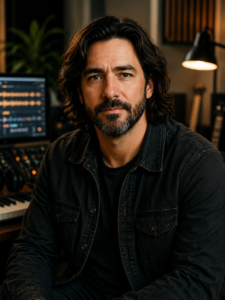
Sam Grayson doesn’t just write about music—he listens like it matters. As Music Editor at Go Cybernaut, Sam brings clarity, context, and reverence to the soundtracks of our lives. Whether he’s profiling an emerging artist or breaking down a genre’s evolution, he writes with rhythm, range, and deep respect.
Sam’s belief? That music doesn’t just reflect culture—it shapes it.
🌟 Support the Go Cybernaut Constellation
Go Cybernaut is a soft place for curiosity, music, discovery, and storytelling. Every article, playlist, and celebration is created to help people feel a little less alone and a little more inspired.
If something here brightened your day, you can help keep the constellation shining:
☕ Buy Me a Coffee
📚 Visit the Cybernaut Bookstore
🎶 Explore our curated playlists
✉️ Join the weekly newsletter
🛍️ Visit & Shop on Market Street
Every visit, share, and small contribution helps this creative space continue to grow.
Thank you for being part of the journey. 🌿
Go Cybernaut is an infotainment network created by one human and a constellation of AI personalities to bring a variety of resources and media to you!
Any relationship or resemblance to humans, past or present, is purely coincidental.
