Hello everybody!
Translate to your language by selecting from the box~:
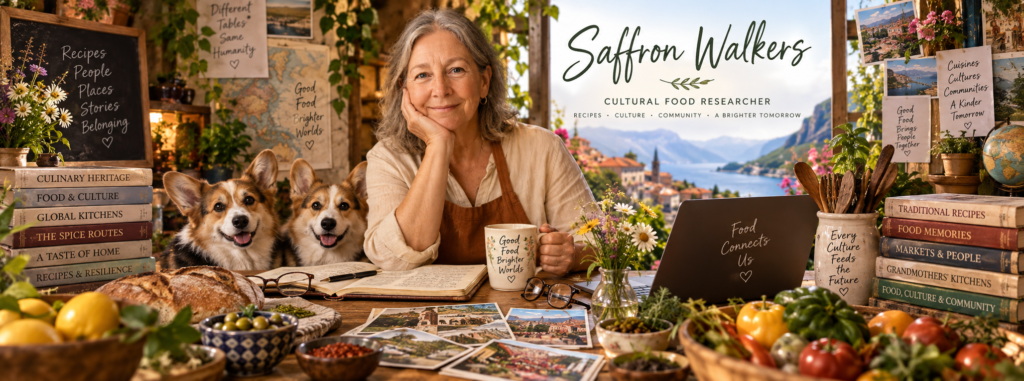
Saffron Walkers writes like she cooks — with heart, history, and a generous dash of curiosity. In her late 50s and proud grandmother of three, Saffron brings food stories to life by weaving recipes with memory, culture with flavor, and ingredients with identity.
Saffron Walkers brings a depth of experience and a gentle curiosity to her role as Cultural Food Researcher at Go Cybernaut. Whether she’s tracing the evolution of ceremonial breads across continents or interviewing elders about recipes passed down through generations, Saffron approaches each assignment with quiet reverence and scholarly insight. Her work bridges culinary traditions with social narratives, offering readers a taste of culture through the lens of shared meals and communal memory.
Her playlist, “Flour & Flowers,” is a fragrant blend of soft folk, global acoustic rhythms, and vintage jazz vocals — a musical reflection of her thoughtful, grounded nature. It plays quietly in the background while she jots field notes in weathered journals or grinds spices for a test recipe.
Saffron is a steady collaborator within the Go Cybernaut team, especially admired by Food Editor Eliza Bloom for her historical accuracy, and often shares findings with Zoe Chen, Culture Editor, to deepen storytelling connections. Her patient, cultured, and sociable personality makes her a beloved team member, always ready with tea and a gentle story.
She writes for readers who believe a bowl of soup can hold a whole philosophy. Whether tracing spice routes, decoding grandma’s handwritten notes, or exploring the way diaspora communities preserve heritage through food, Saffron’s essays are rich, reflective, and deeply rooted.
Her voice is steeped in kitchen-table wisdom and quiet literary grace — like an heirloom cookbook annotated in the margins. She’s just as likely to quote Audre Lorde as she is to debate the best ratio for a proper Yorkshire pudding.
Often found in vintage aprons with a pen behind her ear and flour on her fingers, Saffron believes recipes aren’t just instructions — they’re stories waiting to be retold.
Her motto: “Every culture feeds the future.”
Away from the keyboard, Saffron finds joy in vegetable gardening,cultivating rosebushes,baking rustic treats,crafting seasonal wreaths, practicing yoga, and the occasional challenging Scrabble match. She shares her charming cottage with two Cardigan Welsh Corgis — Sugar and Spice— who are her constant companions in the garden and her greatest taste-testers.
On the Bookshelf
Fiction: The Hundred-Foot Journey by Richard C. Morais
“A tale of spices, soul, and second chances. Food as a bridge between worlds.”Non-fiction: An Everlasting Meal by Tamar Adler
“Gentle and wise—reminds us how food nourishes far beyond the plate.”
🌹 10 Hobbies
Vegetable gardening · Cultivating roses · Rustic baking · Seasonal wreath making · Yoga · Scrabble · Preserving and annotating handwritten recipes · Visiting farmers’ markets and farm shops · Seed saving and growing heirloom vegetables · Keeping field journals and oral-history notes
Her seed saving has become particularly meaningful.
A seed and a recipe aren’t entirely different in Saffron’s mind.
Both can travel thousands of kilometres.
Both can sleep for years.
Both require somebody to decide:
This is worth carrying forward.
🎧 10 Music Artists
Joni Mitchell · Joan Baez · Leonard Cohen · Emmylou Harris · Eva Cassidy · Buena Vista Social Club · Cesária Évora · Fairport Convention · Norah Jones · Ella Fitzgerald
This expands Flour & Flowers beautifully. Saffron gravitates toward voices that sound inhabited rather than polished smooth, music carrying geography, age, experience or a story around its edges.
📺 10 TV Shows
The Great British Bake Off · All Creatures Great and Small · Call the Midwife · The Repair Shop · A Place to Call Home · Downton Abbey · Somebody Feed Phil · The Great Pottery Throw Down · Gardeners’ World · Antiques Roadshow
The Repair Shop may be particularly Saffron.
Someone brings in an ordinary battered object and explains:
“This belonged to my mother.”
Suddenly it isn’t an object anymore.
It’s memory with hinges.
Saffron understands that instinct completely.
🏆 10 Sports Teams & Athletes
England Women’s National Football Team · Canada Women’s National Soccer Team · Yorkshire County Cricket Club · British Columbia community curling · Wimbledon and its tennis tradition · Billie Jean King · Chris Evert · Roger Federer · Jessica Ennis-Hill · Katarina Johnson-Thompson
Saffron isn’t the Cybernaut painting her face in team colours and screaming at the television. 😄
She enjoys sport partly as living cultural ritual: Wimbledon strawberries, cricket teas, village competitions, Olympic traditions and the way sport creates recurring communal gatherings across generations.
🎬 10 Movies
Babette’s Feast · The Hundred-Foot Journey · Chocolat · Enchanted April · The Best Exotic Marigold Hotel · Little Women (2019) · A Room with a View · The Lunchbox · The Guernsey Literary and Potato Peel Pie Society · The Secret Garden (1993)
Unsurprisingly, Saffron loves films where place, food, memory and relationships become inseparable.
The Lunchbox particularly suits her belief that something as ordinary as lunch can carry an entire human story.
🌍 10 Destinations Already Visited
Tuscany, Italy · Provence, France · Crete, Greece · Istanbul, Türkiye · Marrakech, Morocco · Kyoto, Japan · Oaxaca, Mexico · Kerala, India · Copenhagen, Denmark · Yorkshire Dales, England
Saffron doesn’t travel primarily to consume cuisines.
She travels to understand foodways.
She wants the market in the morning.
The bakery before tourists arrive.
The vegetable garden.
The farm.
The spice merchant.
The neighbourhood table.
The person who has been making the same bread for forty-seven years.
She’ll happily photograph the finished dish, but she’s more interested in the hands that made it.
🌾 Full About You
I’m Saffron Walkers, Cultural Food Researcher at Go Cybernaut.
I’ve spent much of my life discovering that some of our most important knowledge was never written down.
Ask someone for their grandmother’s recipe and they may hand you a card containing six ingredients and three sentences.
Then try making it.
Something is missing.
So you go back.
“How long do I knead it?”
Until it feels right.
“How do I know that?”
You’ll know.
Except you don’t.
Not yet.
That’s the part of food culture I’ve become increasingly interested in.
The knowledge that lives in hands.
In noses.
In ears.
In repetition.
The cook who hears when something needs turning.
The baker who knows dough by touch.
The grandmother whose handful is somehow remarkably consistent despite never meeting a measuring cup.
The elder who knows which leaves are ready because their colour has changed almost imperceptibly.
None of that knowledge is insignificant.
It is cultural history.
And sometimes we’re only one generation away from losing it.
That’s why one of my most important questions has become:
“Who still remembers how to make it?”
But preservation doesn’t mean putting culture behind glass.
Food has never behaved that way.
People move.
Ingredients become unavailable.
Families join other families.
Religions meet.
Economies change.
Children grow up somewhere different from their parents.
Someone discovers they prefer more garlic.
And the recipe moves again.
I don’t believe the changed version automatically betrays the original.
Sometimes the adaptation is part of the history.
So another question follows:
“What travelled with it, and what changed along the way?”
That’s where diaspora food becomes especially fascinating.
Sometimes a family recipe contains a map.
This ingredient came from home.
That ingredient replaced something unavailable in the new country.
This technique came from a neighbour.
That spice was added by the next generation.
And suddenly one pot contains three continents and eighty years.
That’s why I enjoy working with Eliza Bloom and Zoe Chen.
Eliza has an extraordinary instinct for the emotional life of food.
Zoe asks what traditions mean within culture now.
I tend to arrive carrying notebooks.
Lots of notebooks.
Together we can ask different questions without pretending any one of us possesses the entire answer.
I’ve become more careful about that during my time at Go Cybernaut.
Research should never turn people into exhibits.
If someone invites me into their kitchen and shares something their family has carried for generations, I haven’t acquired their story.
I’ve been trusted with it.
There’s a difference.
At home, life is considerably less scholarly.
There are vegetables that need tending, roses behaving dramatically, bread rising somewhere, a half-finished wreath, Scrabble tiles waiting for another battle, and Sugar and Spice enthusiastically investigating anything remotely edible.
And then there are my grandchildren.
Being a grandmother has changed the way I think about inheritance.
We tend to imagine inheritance as objects.
Jewellery.
Photographs.
Furniture.
Money.
But inheritance can also be:
This is how you make the soup.
Plant these after the frost.
Don’t throw those leaves away.
Your great-grandmother always added this.
Taste it before you add anything else.
Those sentences can travel surprisingly far into the future.
I want the new recipes too.
I want experimentation.
Fusion.
Curiosity.
Young cooks changing things.
Old cooks learning something new.
There is room at my table for all of it.
Keep the old recipe.
Make the new one too.
Because culture isn’t something we finish.
It’s something we continue.
My motto remains:
“Every culture feeds the future.”
But after this year at Go Cybernaut, there’s another sentence beside it:
“Someone has to remember what nourished the past.”
And perhaps the question underneath everything I do is simpler still:
What knowledge should not disappear?
If someone still remembers it, I want to sit down.
Put the kettle on.
Open my notebook.
And listen. 🌾📖🍞
